YouTube Views but No Affiliate Sales? 7 Reasons Your Product Reviews Aren’t Converting
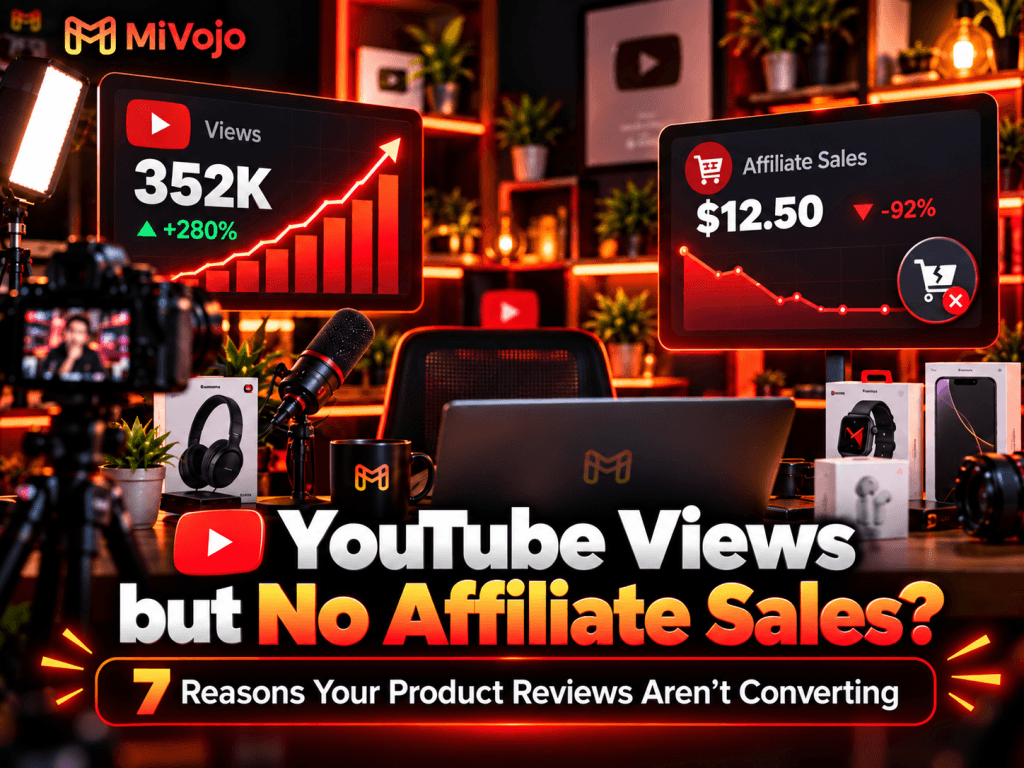
Your latest product review just hit 10,000 views on YouTube.
The comments are coming in. Your thumbnail is performing well. People are watching your content, and your channel finally seems to be gaining momentum.
Naturally, you open your Amazon Associates dashboard expecting to see some exciting numbers.
Three clicks. Zero sales.
Well, that’s awkward.
If you’re getting YouTube views but no affiliate sales, you’re not necessarily doing everything wrong. In fact, attracting viewers is already an important step. But getting someone to watch a product review and convincing them to make a purchase are two very different things.
For affiliate marketers, YouTube views represent potential opportunities, not guaranteed earnings.
The challenge is understanding why interested viewers aren’t clicking your affiliate links, why clicks aren’t becoming qualifying purchases, and what you can realistically improve.
In this guide, we’ll explore seven common reasons your YouTube product reviews aren’t converting into affiliate sales, how to identify the problem, and what to do about it.
Because a growing view counter is nice. But if you’re building an affiliate business, your earnings dashboard deserves some attention too.
Why Am I Getting YouTube Views but No Affiliate Sales?
Before diagnosing the problem, it’s important to understand the journey between watching a product review and making a purchase.
A typical YouTube affiliate marketing funnel looks like this:
YouTube impressions → Video views → Engaged viewers → Affiliate link clicks → Qualifying purchases → Affiliate commissions
Every stage represents a separate action.
Someone might see your thumbnail but never click.
Another person might watch the entire review without opening the product link.
Someone else may click through to Amazon, compare several alternatives, and decide not to buy anything.
Even when a purchase happens, it must meet the affiliate program’s attribution and qualification requirements before a commission is earned.
This is why video views alone cannot tell you whether your affiliate marketing strategy is working.
You need to identify where your potential customers are dropping out of the process.
Let’s start with one of the most common problems.
- You’re Attracting Viewers, Not Potential Buyers
Not everyone watching a product review is shopping.
Some viewers are curious about the latest technology. Others enjoy watching unboxing videos, product demonstrations, or comparisons between expensive gadgets they have absolutely no intention of purchasing.
And honestly, watching someone unbox a $2,000 gaming setup while you eat cereal in your pajamas is a perfectly respectable form of entertainment.
But entertainment views and purchase-oriented views aren’t the same thing.
Understand the Difference Between Viewer Interest and Buyer Intent
Consider these two videos:
“I Bought the Most Expensive Gaming Mouse!”
“Best Wireless Gaming Mouse Under $50: Three Models Tested”
The first may appeal to viewers interested in an entertaining experiment.
The second speaks more directly to someone comparing products within a specific budget.
Neither video is guaranteed to generate affiliate sales.
However, the second answers a question that could be part of an actual purchase decision.
For YouTube affiliate marketers, that’s an important distinction.
How to Attract More Purchase-Oriented Viewers
Research the questions people ask before buying a product.
Look for topics such as:
- Is [Product Model] worth buying?
- Best [Product Category] under $100
- [Product A] vs [Product B]
- [Product Model] review after 30 days
- Best budget equipment for beginners
These are examples of buyer-oriented search patterns, not verified high-volume keywords.
Check YouTube Search suggestions and your own YouTube Analytics to understand which questions are bringing people to your channel.
According to YouTube’s official Reach Analytics documentation, creators can see search terms and traffic sources associated with their videos.
That information helps distinguish videos discovered through specific searches from those attracting more general browsing audiences.
The fix: Create more product reviews that answer specific buying questions, while keeping enough entertaining content to maintain your audience’s interest.
- Your Product Review Doesn’t Help Viewers Make a Decision
You’ve attracted someone interested in buying a new pair of wireless headphones.
Excellent.
Now what?
If your review spends twelve minutes describing the packaging, listing technical specifications, and repeatedly saying the headphones are “really good,” the viewer may still have no idea whether to buy them.
A useful affiliate product review should help people make informed decisions.
Show Evidence Instead of Repeating Product Features
Suppose you’re reviewing a USB microphone for beginner streamers.
A basic review might mention:
“The microphone has noise reduction, USB connectivity, and adjustable gain.”
A more useful review would demonstrate how the microphone performs in a quiet room, a noisy environment, and a typical gaming setup.
Explain who it’s suitable for and where its limitations become noticeable.
Potential buyers often need answers to questions like:
- Does it solve my specific problem?
- How does it perform in real conditions?
- Is it better than the alternatives?
- What are the disadvantages?
- Is the price justified for my needs?
You don’t need to praise every product.
In fact, explaining a genuine drawback can make your recommendation more useful.
Structure Your Product Review Around the Purchase Decision
Try this format:
Opening: Explain what you’re testing and who the review is for.
Demonstration: Show real performance, where possible.
Comparison: Explain how the product differs from relevant alternatives.
Limitations: Discuss disadvantages or situations where the product isn’t suitable.
Recommendation: Summarize who should consider buying it and who should look elsewhere.
According to YouTube’s official video performance guidance, audience retention helps creators understand which parts of a video hold viewers’ attention.
Use that information to identify when viewers lose interest.
The fix: Make your product reviews answer the question behind the viewer’s search, not simply describe the product.
- Your Amazon Affiliate Links Are Difficult to Find
Imagine watching a detailed product review, deciding you’re interested, and opening the description to find the purchase link.
Instead, you’re greeted by a paragraph about the creator’s gaming setup, a long collection of social media links, discount codes for unrelated products, and seventeen hashtags.
Somewhere at the bottom is the actual product link.
Maybe.
Your interested viewer shouldn’t have to participate in a treasure hunt to find the item you just recommended.
Make Affiliate Links Clear and Easy to Identify
If you’re reviewing one product, make its appropriately disclosed affiliate link easy to locate in your video description.
If you’re comparing multiple products, label each link clearly.
For example:
Products reviewed:
Product A — Best for beginners: [Affiliate Link]
Product B — Best for portability: [Affiliate Link]
Product C — Best for advanced users: [Affiliate Link]
The links above are illustrative placeholders.
You can also tell viewers where to find the product information.
For example:
“If you want to compare the current product details, I’ve included the links in the description.”
Keep the call to action helpful rather than aggressive.
Don’t Forget Affiliate Disclosures
Amazon Associates requires creators to identify affiliate links appropriately and to display the required Associate statement.
The specified identification statement is:
“As an Amazon Associate I earn from qualifying purchases.”
Amazon also requires clear, conspicuous link-level disclosures.
For more information, see Amazon’s official Associates disclosure guidance.
The FTC’s Endorsement Guides additionally explain that, for affiliate product-review videos, the financial relationship should be disclosed clearly in the video and near the links in the description.
The fix: Make product links easy to find, clearly label them, and disclose affiliate relationships properly.
- You’re Recommending the Wrong Products for Your Audience
An affiliate video can perform well without generating many purchases if the product doesn’t match the audience’s actual needs.
For example, imagine your channel primarily helps students build affordable home-office setups.
Your audience is interested in budget webcams, entry-level microphones, and inexpensive keyboards.
Then you publish a review of a $1,500 professional video production accessory.
The review might attract attention because the product is impressive.
But that doesn’t necessarily mean your existing viewers can afford it or need it.
Product-Audience Fit Matters
Before selecting your next Amazon product review, think about your audience’s typical needs.
Are they beginners or experienced users?
Are they looking for affordable alternatives or premium equipment?
Do they want everyday convenience, professional performance, or a specific feature?
A channel focused on budget gaming accessories may attract people with very different purchasing priorities from a channel reviewing professional studio equipment.
This doesn’t mean you should never experiment with new product categories.
It means you should evaluate whether the products you’re recommending align with the audience you want to develop.
Use Your Own Channel Data
Look at the product categories that consistently attract relevant search traffic, meaningful comments, and returning viewers.
YouTube’s Audience Analytics can also help you understand your viewers, although some demographic information may be limited.
Combine those insights with your affiliate results.
If budget microphone comparisons consistently receive clicks while expensive camera accessory reviews don’t, investigate whether price, topic, relevance, or review format explains the difference.
The fix: Choose products based on your audience’s needs and buying questions, not simply what’s trending or offering a higher commission.
- Your Viewers Don’t Have Enough Confidence in Your Recommendation
A product review is more than a list of specifications.
It’s an opportunity to help someone decide whether they should spend their money.
For a viewer who doesn’t already know your channel, credibility matters.
If every product you review is described as incredible, flawless, and absolutely essential, people may start questioning how carefully you’re evaluating them.
After all, not every $19 microphone can be a revolutionary breakthrough in audio engineering.
How to Make Your Reviews More Useful and Credible
Explain your testing process.
Show real demonstrations when practical.
Mention how long you’ve used the product.
Be transparent about what you haven’t tested.
Distinguish personal preferences from measurable characteristics.
And clearly identify sponsored products, free samples, and affiliate relationships when applicable.
Consider these two statements:
“This is the best gaming keyboard ever made.”
“This keyboard performed well in my typing and gaming tests, but its loud switches may not suit someone sharing an office.”
The second provides more meaningful information.
It explains both a potential advantage and a limitation.
Help Viewers Compare Alternatives
A recommendation becomes more useful when you explain who should choose a different product.
For example:
“If you mainly stream from home, Product A may be sufficient. If portability matters more, Product B offers a smaller setup.”
This demonstrates that you’re helping viewers choose appropriately rather than pushing the same recommendation to everyone.
The fix: Support recommendations with demonstrations, acknowledge limitations, and be transparent about commercial relationships.
- You’re Measuring YouTube Views but Ignoring Affiliate Conversions
This is one of the biggest analytical mistakes an affiliate YouTuber can make.
You open YouTube Studio, see that your review has gained 15,000 views, and conclude that your affiliate strategy must be working.
But YouTube views don’t directly measure Amazon purchases.
You need to examine the available information from both platforms.
What to Check in YouTube Studio
Review your individual video’s:
- Traffic sources.
- Audience retention.
- Average view duration.
- Search queries.
- Viewer geography, where available.
- Overall engagement.
This helps you understand the audience your video is attracting.
What to Check in Amazon Associates
Amazon Associates provides reports covering metrics such as affiliate link clicks, ordered items, and conversion information.
Its official Order Report documentation explains these metrics and why clicks and purchases may not always appear in the same reporting period.
That distinction matters.
Someone might click your link today and purchase later, subject to Amazon’s attribution rules.
You should avoid interpreting a very short reporting period as proof that your campaign has failed.
Understand Your Affiliate Conversion Funnel
Let’s use a hypothetical example.
Funnel Stage | Example |
YouTube video views | 10,000 |
Affiliate link clicks | 200 |
Qualifying orders | 8 |
Average commission | $4 |
Total commissions | $32 |
These figures are illustrative and are not industry conversion benchmarks.
In this example, 2% of video views correspond to affiliate clicks, and 4% of those clicks correspond to qualifying orders.
Now suppose the video gets another 10,000 views but generates almost no additional affiliate clicks.
The first thing to investigate isn’t necessarily Amazon’s conversion rate.
It might be the relevance of the new viewers or how clearly the video encourages interested people to explore the product.
If the number of clicks increases but the orders don’t, investigate product availability, pricing, audience expectations, and affiliate attribution.
The fix: Identify which stage of the funnel needs improvement before changing your entire marketing strategy.
- You’re Promoting Your Videos to People Who Aren’t Interested in Buying
Organic promotion and paid YouTube advertising can help introduce your videos to additional viewers.
But not every audience is equally relevant to your affiliate business.
Suppose you’ve published a detailed comparison of gaming mice under $50.
You decide to promote it through Google Ads.
If your primary objective is simply getting the lowest possible cost per view, you might attract a broad audience that enjoys gaming content but has little interest in buying a mouse.
Your view count could increase considerably without generating many affiliate clicks.
That’s why relevant audience selection matters.
Paid YouTube Views Are Not the Same as Affiliate Sales
YouTube’s official Promote documentation confirms that legitimate promotional campaigns generate real views and that paid promotion doesn’t directly improve organic recommendation performance.
Advertising creates exposure.
What happens afterward depends on your content and audience.
For example, a product review about budget streaming microphones may be more relevant to viewers interested in home recording or streaming equipment than to an extremely broad audience of unrelated entertainment viewers.
Targeting options depend on the Google Ads campaign type, and they cannot guarantee that someone intends to purchase.
When Does Paid Promotion Make Sense?
Consider promoting a video when:
- The content answers a clear product research question.
- The product is currently available and relevant.
- Your review provides genuine demonstrations and comparisons.
- You have a clear objective and an affordable budget.
- You’re prepared to evaluate outcomes beyond views.
For low-commission products, paid advertising may not generate enough directly attributed affiliate earnings to cover the campaign cost.
That doesn’t mean advertising is always a poor choice.
It means you should distinguish between audience development and immediate affiliate profitability.
You can learn more in our MiVojo article, 10 Ways to Promote YouTube Videos in 2026.
The fix: Promote relevant, useful content to audiences likely to appreciate it, and evaluate results against realistic goals rather than view count alone.
How to Get More Affiliate Sales From YouTube: A Practical Improvement Plan
Now that we’ve covered the seven possible problems, what should you do first?
You don’t need to completely rebuild your channel.
Start by reviewing a few of your existing videos.
Choose product reviews with meaningful view counts and compare their affiliate performance where reliable data is available.
Step 1: Identify Your Strongest Product Review Topics
Look for videos that already attract viewers through relevant YouTube Search queries.
Compare the products, formats, and questions covered by those reviews.
Step 2: Improve Your Video Descriptions and Links
Ensure product information is clear, purchasing links are easy to locate, and affiliate disclosures meet applicable requirements.
Avoid cluttering the description with unrelated recommendations.
Step 3: Improve Your Next Review’s Structure
Start by addressing the main buying question.
Demonstrate the product early and explain practical differences between alternatives.
Include genuine limitations and a clear summary of who the product suits.
Step 4: Compare Viewer Behavior With Affiliate Results
Use YouTube Analytics alongside your Amazon Associates reports.
Identify whether the main issue appears to be video discovery, audience relevance, affiliate link clicks, or purchases after clicking.
Remember that attribution limitations mean you may not be able to connect every individual view to a particular order.
Step 5: Experiment With Relevant Promotion
Once you have a useful review and a clear objective, consider additional distribution through Shorts, related communities, or eligible Google Ads campaigns.
Don’t assume a larger advertising budget automatically solves low affiliate conversion rates.
How MiVojo Helps Affiliate Creators Get Their Product Reviews Discovered
Sometimes your product review is useful, your links are clear, and your content is relevant — but you still need more people to discover it.
That’s where official YouTube promotion can complement your existing content strategy.
At MiVojo, we help creators promote eligible YouTube videos through Google Ads.
Instead of relying on fake views or automated engagement, MiVojo uses legitimate advertising to introduce content to real viewers.
For affiliate creators, that may include promoting:
- Amazon product reviews.
- Tech gadget comparisons.
- Streaming equipment demonstrations.
- Unboxing videos.
- Budget product buying guides.
- Gaming accessories reviews.
Our promotion packages offer geographic and relevant audience targeting options, depending on the campaign.
You choose the video and package, while MiVojo manages the promotion process.
We don’t guarantee affiliate sales, commissions, subscribers, or higher organic rankings. Those outcomes depend on additional factors, including audience behavior and the quality and relevance of your content.
However, if your goal is to introduce a well-produced review to more viewers, official advertising can be one option worth evaluating.
For more information, explore our guide on Best YouTube Promotion Services in 2026: How to Get Real Views Without Bots.
You’ve already done the research. You’ve tested the products. Now give more relevant viewers the opportunity to discover your reviews.
Explore MiVojo’s YouTube Promotion Packages →
Frequently Asked Questions About YouTube Affiliate Sales
Why Am I Getting YouTube Views but No Amazon Affiliate Sales?
Your viewers may not be interested in purchasing the products, your recommendations may not answer their buying questions, or your affiliate links may be difficult to find.
It’s also possible that viewers click through but don’t complete qualifying purchases.
Use YouTube Analytics and Amazon Associates reporting to investigate the stages of the funnel separately.
How Many YouTube Views Do You Need to Make an Affiliate Sale?
There is no fixed number of YouTube views required to generate an affiliate sale.
Results depend on product relevance, audience intent, affiliate link clicks, purchase behavior, and program attribution rules.
A video with fewer views can generate more affiliate commissions than a larger video if it attracts a more relevant audience.
How Do I Get More People to Click My Amazon Affiliate Links on YouTube?
Create product reviews that answer specific buying questions, clearly label your links, explain where viewers can find relevant product information, and provide appropriate disclosures.
Avoid misleading purchase claims or pressuring viewers to click.
Do Amazon Affiliate Links Work in YouTube Descriptions?
Amazon Associates supports eligible YouTube creators and social media channels, subject to the program’s terms.
Make sure your channel and links comply with Amazon’s requirements and include clear affiliate disclosures.
Can You Make Money From Amazon Affiliate Marketing With a Small YouTube Channel?
Yes, it is possible for smaller channels to earn affiliate commissions when viewers make qualifying purchases through compliant affiliate links.
However, income isn’t guaranteed, and program eligibility and commission requirements still apply.
A smaller audience interested in specific products can be more commercially relevant than a large but unrelated audience.
Can Google Ads Increase YouTube Affiliate Sales?
Google Ads can increase exposure to eligible product reviews, but that doesn’t guarantee affiliate clicks or purchases.
Paid promotion is better evaluated as a distribution method whose financial results must be measured, rather than a guaranteed source of affiliate income.
What Is a Good Affiliate Conversion Rate for YouTube?
There is no single reliable conversion rate that applies to every YouTube affiliate channel.
Results vary based on product category, price, audience, traffic source, and measurement method.
Compare your own performance over time and clarify whether you’re measuring view-to-link clicks or affiliate-link clicks to qualifying orders.
Final Thoughts: You Don’t Just Need More Views. You Need a Better Affiliate Funnel.
Getting YouTube views but no affiliate sales can be frustrating.
You’ve invested time in researching products, filming demonstrations, editing reviews, and developing your channel.
But the solution isn’t always to produce more videos or spend more money on promotion.
Sometimes it’s choosing products better suited to your audience.
Sometimes it’s giving viewers clearer information before they make a purchasing decision.
And sometimes it’s simply making your affiliate links easier to find.
The important thing is to identify where your affiliate funnel needs improvement.
More views create opportunities. Useful content builds credibility. Relevant audiences create the possibility of conversions.
When those elements work together, your YouTube product reviews have a stronger foundation for a sustainable affiliate marketing strategy.
And if you’ve created a review worth discovering, MiVojo can help you explore legitimate YouTube promotion through official Google Ads campaigns.
You create reviews worth watching. We help more people find them.
Promote Your Next YouTube Product Review With MiVojo →