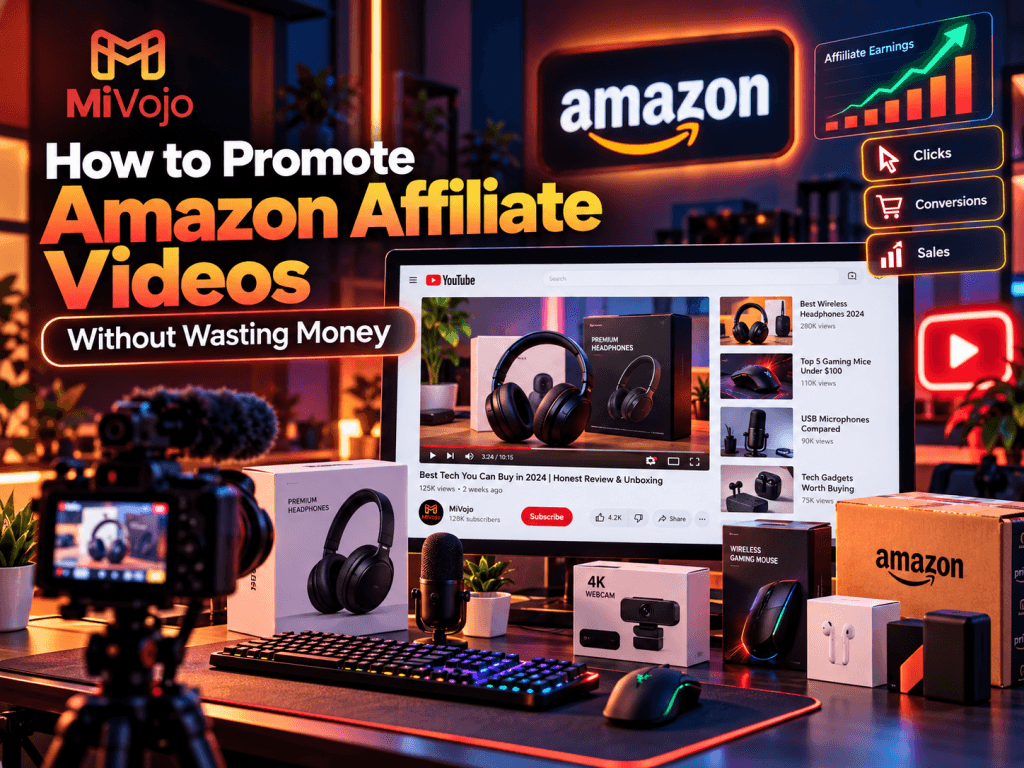
How to Promote Amazon Affiliate Videos on YouTube Without Wasting Money
You’ve spent hours reviewing a product, testing its features, editing your video, and carefully adding your Amazon affiliate links.
The video looks great. Your thumbnail is polished. You’ve even managed to explain every feature without saying “basically” forty-seven times.
Now comes the difficult part.
How do you get people to watch your Amazon affiliate videos without spending more on promotion than you could possibly earn in commissions?
For YouTube affiliate marketers, this is one of the most important questions to answer before investing in advertising.
Getting more views is exciting. But if you’re paying to promote a $30 product that earns you a small commission per sale, the numbers can become uncomfortable very quickly.
The good news? You don’t necessarily need a huge marketing budget to introduce your product reviews to relevant viewers.
You need a strategy that combines YouTube SEO, audience targeting, smart video promotion, and realistic expectations about affiliate revenue.
In this guide, we’ll explain how to promote Amazon affiliate videos on YouTube in 2026, when paid promotion makes sense, and how to avoid spending money on views that do little for your affiliate business.
Why Promoting Amazon Affiliate Videos Is Different From Promoting Regular YouTube Content
If you’re a gaming creator, musician, or lifestyle YouTuber, your primary goal might be reaching more viewers, building an audience, or increasing brand awareness.
For Amazon affiliate creators, there’s another consideration.
You want people to watch your content, trust your recommendations, and potentially make qualifying purchases through your affiliate links.
That creates a more complex journey.
A potential customer might:
- Discover your review on YouTube.
- Watch your product demonstration.
- Compare the product with an alternative.
- Click your Amazon affiliate link.
- Decide whether to purchase.
Not everyone will complete this journey.
Some viewers only want entertainment. Others are researching products without intending to buy immediately. Some may watch multiple reviews before making a decision.
That’s why 10,000 views from people with little interest in your product may generate less affiliate value than 1,000 views from a highly relevant audience.
The objective isn’t simply to maximize video views.
It’s to make your content discoverable to the people most likely to benefit from your recommendations.
- Promote Product Reviews With Clear Buying Intent
Before spending money on promotion, look at the type of video you’re planning to advertise.
Not all product review formats serve the same audience needs.
Consider these titles:
- “My New Gaming Setup!”
- “Best Gaming Mouse Under $50: Five Models Tested”
- “Logitech G502 Review: Is It Still Worth Buying?”
- “USB vs XLR Microphones: Which Should Beginners Choose?”
The first title may attract viewers interested in someone’s personal gaming setup.
The others answer more specific product research questions.
This distinction matters because people researching a particular product or comparison may be closer to making a purchase decision.
Three Product Review Formats Worth Prioritizing
Individual product reviews: These answer specific questions about performance, usability, features, and value.
Comparison videos: These help viewers choose between two or more products.
Buying guides: These explore options within a category, such as the best streaming microphones for beginners or affordable gaming keyboards.
None of these formats guarantees affiliate conversions.
However, they can help you build content around the questions potential buyers are already asking.
For example, if someone is searching for “best budget webcam for Zoom meetings,” a detailed comparison of affordable webcams is more directly relevant than a general office equipment unboxing.
Before promoting a review, ask:
Does this video answer a question that someone interested in buying the product would genuinely want answered?
If the answer is no, improving the video may be a better investment than increasing its advertising budget.
- Optimize Your Amazon Affiliate Videos for YouTube Search First
One of the most cost-effective ways to support YouTube product review promotion is to improve your video’s organic discoverability.
YouTube Search can help people find reviews that match their research questions, without requiring you to pay for each discovery.
According to YouTube’s official Analytics guidance, creators can examine the search terms bringing viewers to their content.
This information is particularly useful for product review channels.
Choose Keywords That Match Product Research
Imagine you’re reviewing a budget microphone.
Potential search topics might include:
- Best USB microphone for streaming
- Budget microphone for YouTube
- USB microphone sound test
- USB vs XLR microphone
- Affordable microphone for gaming
These are examples of relevant keyword themes, not verified monthly search-volume figures.
Your title should accurately describe your video and naturally include the main topic.
For example:
“Best USB Microphone Under $100? Sound Test & Honest Review”
Your description can explain the products tested, the key features covered, and the type of viewer who might benefit.
You can also use chapters to help viewers navigate between tests, comparisons, and recommendations.
Don’t Forget Your Thumbnail
A good thumbnail makes the product recognizable and communicates the review’s main value.
For comparison videos, consider featuring the products side by side.
For individual reviews, highlight the actual product and a relevant question.
Avoid misleading claims or exaggerated graphics that don’t reflect the review.
If your video promises a detailed battery test, viewers should actually find one.
Your thumbnail’s job is to earn a relevant click, not win an award for the most dramatic facial expression.
For a broader introduction to video discovery, read our 10 Ways to Promote YouTube Videos in 2026.
- Promote Your Amazon Affiliate Reviews Without Paying for Ads
Before investing in Google Ads, explore the free distribution opportunities available to you.
Organic promotion is particularly valuable when your affiliate commissions are relatively small.
You can introduce product reviews to new audiences through your existing social media presence, related YouTube content, and relevant online communities.
But here’s the important part: share information people actually need.
Use Your Product Reviews to Answer Real Questions
Suppose someone asks an online gaming community whether a particular headset has a good microphone.
You’ve already tested that exact headset.
Instead of immediately posting your YouTube link, explain what your testing revealed.
If the community permits relevant self-promotion, you can share the video as an additional resource.
This approach is more useful than posting “CHECK OUT MY LATEST REVIEW” beneath every unrelated discussion.
Repurpose Long Reviews Into YouTube Shorts
A detailed product review can contain several moments worth sharing separately.
For example, a 12-minute headphone review might produce:
- A short microphone quality demonstration.
- A quick comparison between two products.
- A clip showing one unexpected drawback.
- A brief explanation of who the product is best suited for.
These clips can introduce your review style to viewers who aren’t familiar with your channel.
Eligible YouTube creators can also connect Shorts to related channel content using YouTube’s available features.
Shorts aren’t guaranteed to send viewers to your full review, but they provide another opportunity for product discovery.
Build Related Product Review Playlists
If you regularly review similar products, organize them into useful playlists.
For example:
“Best Budget Streaming Equipment”
“Gaming Mouse Reviews & Comparisons”
“Affordable Tech Accessories Tested”
A viewer who enjoys one review may want to watch another before making a decision.
That gives your channel more opportunities to demonstrate expertise rather than treating every video as an isolated upload.
- Can You Use Google Ads to Promote Amazon Affiliate YouTube Videos?
Yes, eligible product review videos can be promoted using Google Ads, provided the advertising content, associated links, and promotional practices comply with the applicable Google and affiliate-program policies.
However, there is an important distinction.
Promoting your own YouTube product review is not the same as purchasing a search advertisement that sends users directly to Amazon through an affiliate link.
Under the Amazon Associates Program Participation Requirements, certain paid search placements are prohibited, including arrangements that send users directly or indirectly through redirecting links to Amazon instead of the Associate’s own site.
Amazon also places restrictions on its trademarks, advertising content, and other promotional practices.
Therefore, before advertising your affiliate content, check your specific Amazon Associates agreement, the sites and social accounts registered with your account, and the campaign’s destination and creative.
An advertisement that promotes an independently produced YouTube review can have a different structure from a paid search ad linking directly to an Amazon product page. That does not mean every such video campaign is automatically permitted.
What Google Ads Can Help You Achieve
Google Ads offers video campaigns intended to help advertisers reach audiences on YouTube and other eligible placements.
Depending on your campaign settings, targeting options may include:
- Geographic locations and languages.
- Demographic groups.
- Interest-based audience segments.
- In-market audiences.
- Relevant topics or keywords.
- Certain YouTube channels or videos.
Not every targeting method is available with every campaign objective.
You can learn more from Google’s official Video Campaign targeting guide.
For affiliate marketers, audience relevance is especially important.
A review about a gaming keyboard is unlikely to benefit equally from every possible viewer.
It’s more reasonable to test audiences interested in gaming accessories, mechanical keyboards, or related technology categories, using the targeting options supported by the selected campaign.
- Target Potential Buyers, Not Just Cheap Views
One of the easiest ways to waste your YouTube promotion budget is to optimize exclusively for the lowest possible cost per view.
Cheap views can look impressive.
But if you’re reviewing a specialized product, attracting a large audience with little interest in that category may not be particularly useful.
Example: Promoting a Gaming Mouse Review
Imagine you’ve created a video titled:
“Best Wireless Gaming Mouse Under $50: Three Models Compared.”
You could promote it very broadly to people interested in technology.
Alternatively, you might test a more relevant audience interested in PC gaming accessories and related product categories.
The second approach may cost more per view, depending on competition and campaign settings.
However, it could attract viewers who are more interested in the subject of the review.
The important word is could.
Targeting increases your ability to select an intended audience; it doesn’t guarantee purchase intent or affiliate sales.
Geographic Targeting Matters Too
If your product recommendations and Amazon affiliate links primarily serve U.S. shoppers, a campaign targeting the United States may be more relevant than a worldwide campaign.
But don’t assume every person in the United States is a potential buyer.
Review your product category, audience interests, and affiliate program coverage.
The right approach depends on where your intended customers are located and which Amazon marketplace your links support.
A higher-cost audience can still be worth testing, but only if you evaluate performance against your actual goals.
- Calculate Your Affiliate Advertising Budget Before Spending Money
Here’s where affiliate video promotion becomes a little less glamorous.
We’re going to do some math.
Don’t worry. No complicated spreadsheets are required just yet.
The most important question is:
How much affiliate commission could you realistically earn from the traffic you’re paying to attract?
Let’s use a hypothetical example.
Suppose you promote a product that costs $100 and generates a hypothetical 4% commission on a qualifying purchase.
That means one qualifying order earns $4 before considering adjustments or other costs.
Now imagine you pay $50 for advertising.
You would need at least 13 qualifying orders worth $4 each to earn more than your advertising spend.
And that’s before considering the time and cost of producing your video.
But it did not recover its advertising costs through the hypothetical affiliate purchases.
The video might still have introduced the creator to new potential subscribers or future customers. Those outcomes could have value, but they shouldn’t be confused with immediate affiliate profit.
A Simple Break-Even Formula
To estimate your required results, start with:
Break-even purchases = Advertising cost ÷ Commission per qualifying purchase
Because you can’t earn half a qualifying purchase, you would need at least 13 such purchases to exceed the $50 spend.
For a more complete analysis, also consider your expected affiliate link click rate and the share of clicks that become qualifying orders.
Actual Amazon commissions vary by product category and program terms.
Check your current category-specific commission rates before estimating revenue.
- Decide Whether a Product Review Is Worth Promoting
Not every video deserves a paid campaign.
And that’s perfectly fine.
Some reviews are better suited to organic search, while others might benefit from additional paid exposure.
Before investing, evaluate three things.
Product Economics
How much commission does the product generate?
A low-cost item with a small commission leaves little room for paid customer acquisition.
A higher-value item may offer more potential revenue per qualifying order, depending on the applicable commission structure.
But a higher price doesn’t necessarily mean more purchases.
Existing Audience Interest
Does your review already attract relevant viewers?
Check your YouTube traffic sources, average view duration, and viewer engagement.
If a review consistently answers relevant search queries and receives positive responses, it may be worth testing with additional distribution.
On the other hand, if viewers frequently leave before you begin demonstrating the product, consider improving the content first.
Advertising can’t repair a confusing review.
It can only expose that review to more people.
Product Availability and Relevance
Make sure the product is still available and that your review remains accurate.
If you’re promoting an older smartphone comparison, for example, check whether the devices and prices are still relevant.
A video recommending products that viewers can no longer purchase may deliver limited affiliate value.
- How to Promote Amazon Affiliate Videos With a Small Budget
You don’t need to spend hundreds of dollars immediately to explore paid video promotion.
A limited test can help you understand costs and audience response before committing more money.
For example, a creator might choose a fixed test budget of $30–$50, depending on what they can comfortably afford to lose.
This isn’t a promise that a particular budget will generate meaningful results.
It’s a way to establish a spending limit.
A Practical Testing Approach
Step 1: Choose one review.
Select a video that answers a specific buying question and provides useful information.
Step 2: Define the audience.
Consider location, product category, and relevant audience interests.
Step 3: Set a maximum budget.
Decide how much you are comfortable spending before the campaign begins.
Step 4: Run the eligible promotion.
Use the campaign objective and targeting options that fit your goals.
Step 5: Review the results.
Measure paid views and costs, but also look for relevant engagement, subscriber activity, and affiliate results where available.
Step 6: Decide whether to continue.
Don’t automatically increase spending simply because the video received more views.
Evaluate whether the promotion is serving your business objective.
According to Google’s official guidance on Video campaign objectives, different campaign goals are designed to optimize for different outcomes.
A campaign optimized for views shouldn’t be treated as though it were automatically optimized for affiliate purchases.
- Use YouTube Analytics and Amazon Associates Reports Together
If you’re an Amazon affiliate marketer, views are only one part of the story.
YouTube Studio helps you understand video performance.
Amazon Associates reporting helps you analyze activity associated with your affiliate links.
You need both perspectives to evaluate whether your promotion strategy makes sense.
What to Track in YouTube Studio
Pay attention to:
- Views and traffic sources.
- Audience retention.
- Average view duration.
- Subscribers gained.
- Search queries.
- Viewer engagement.
YouTube’s official impressions and watch time report can help you examine how video thumbnails generate views and watch time.
Remember that advertising views and organic impressions are measured differently in some reports.
Compare metrics carefully rather than assuming every traffic source behaves identically.
What to Track in Amazon Associates
Review the reporting metrics available in your Associates account, such as clicks, ordered items, qualifying purchases, and commission income.
Where permitted, use tracking IDs to help organize your affiliate activity.
However, don’t assume that Amazon automatically attributes a purchase to a particular Google Ads campaign.
Attribution is often more limited than creators expect, especially when people encounter content across multiple devices or sessions.
Understand Your Real Objective
If you’re purchasing video promotion primarily to generate affiliate sales, compare advertising cost with attributed commission revenue.
If you’re also trying to develop a recognizable review channel, monitor new viewers and channel engagement as secondary indicators.
Both objectives are legitimate.
They’re simply not the same thing.
- Promote Amazon Affiliate Videos With MiVojo
If you want to introduce your YouTube product reviews to additional viewers without managing every detail of a Google Ads campaign yourself, a managed promotion service may be worth considering.
At MiVojo, we help YouTube creators promote eligible videos through official Google Ads campaigns.
Our service is designed for creators who want legitimate advertising exposure rather than artificial views generated by bots or automated traffic.
For affiliate marketers, this may be useful when promoting content such as:
- Technology product reviews.
- Gaming accessory comparisons.
- Streaming equipment tutorials.
- Product demonstrations.
- Buying guides.
- Consumer electronics reviews.
How MiVojo Works
The process is straightforward.
You choose a YouTube promotion package, submit the URL of your video, and select the available targeting options that fit your campaign.
MiVojo manages the advertising process through Google Ads.
There’s no need to share your YouTube password or provide access to your channel.
You can explore country-based targeting and relevant audience interests, depending on the chosen service and campaign capabilities.
We focus on real viewers and legitimate video advertising.
What we don’t promise: guaranteed Amazon purchases, affiliate commissions, subscribers, or improvements in organic YouTube rankings.
Those outcomes depend on factors beyond the delivery of paid video views.
If you want to understand how to evaluate promotional providers, read our article on Best YouTube Promotion Services in 2026: How to Get Real Views Without Bots.
You’ve already done the work of creating a useful product review. Now give more relevant viewers a chance to discover it.
Explore MiVojo’s YouTube Promotion Packages →
- Common Mistakes That Waste Amazon Affiliate Promotion Budgets
Before launching your next campaign, avoid these common problems.
Paying for Views Without Considering the Audience
A large view count is not proof that you’ve reached potential customers.
Consider how closely your audience targeting matches the products you’re reviewing.
Promoting a Video With a Weak Opening
If your video takes several minutes to explain what product you’re reviewing, new viewers may lose interest.
Start with the question your review answers and show useful evidence early.
Expecting Advertising to Fix Organic Rankings
YouTube states that paid promotion doesn’t directly determine how content performs in its organic recommendation system.
Legitimate advertising can increase exposure, but it doesn’t purchase a better organic ranking.
Ignoring Affiliate Program Rules
Amazon Associates requires compliant promotional practices and disclosures.
Never assume that an advertising method is permitted simply because a Google Ads campaign can technically be created.
Increasing Budgets Without Measuring Results
If a campaign isn’t producing valuable outcomes, doubling the budget doesn’t automatically improve its economics.
Review performance, adjust where appropriate, and set clear limits.
Using Fake Traffic or Artificial Engagement
Avoid services offering bot-generated views, artificial clicks, or guaranteed affiliate purchases.
These methods can violate platform rules and create serious problems for your business.
- Follow Amazon Associates and FTC Disclosure Requirements
Affiliate marketing works best when viewers understand your relationship with the products you recommend.
Amazon requires participating Associates to use the appropriate affiliate disclosures and identify themselves according to the program’s terms.
The required Associate statement is:
“As an Amazon Associate I earn from qualifying purchases.”
Amazon also expects clear disclosures near affiliate links.
See the official Amazon Associates disclosure guidance.
If you’re addressing U.S. consumers, the Federal Trade Commission also provides guidance on disclosing material relationships.
The FTC explains that affiliate or sponsorship disclosures in videos should be clear and difficult to miss, rather than hidden only in descriptions or buried beneath links.
You can review the FTC’s Disclosures 101 guidance for creators.
You should also follow YouTube’s rules on paid product placements and endorsements where applicable.
Clear disclosure helps viewers understand whether you’re receiving compensation or may earn a commission.
And being transparent doesn’t make your review less valuable.
If anything, it gives viewers more context for evaluating your recommendation.
- A 30-Day Amazon Affiliate Video Promotion Plan
If you’re trying to promote your YouTube affiliate content without overspending, start with a manageable plan.
Week | Main Action |
Week 1 | Identify reviews with relevant search interest and improve titles, thumbnails, and descriptions |
Week 2 | Publish useful Shorts and share reviews through appropriate organic channels |
Week 3 | Test a limited paid promotion budget on an eligible, relevant video |
Week 4 | Compare advertising costs, audience response, and available affiliate reporting before deciding what to do next |
The goal isn’t to spend more money every month.
It’s to understand which content and distribution methods are actually worth further investment.
You might discover that product comparisons consistently outperform basic unboxings.
Perhaps your audience is more interested in budget streaming equipment than premium gaming accessories.
Or maybe an organic review provides better financial results than an advertised one.
Those findings are useful.
A successful affiliate strategy should be willing to stop spending money when the numbers don’t support continuing.
Frequently Asked Questions About Promoting Amazon Affiliate Videos
Can You Promote Amazon Affiliate Videos With Google Ads?
Eligible YouTube product review videos can be advertised through Google Ads when the campaigns and associated content comply with Google’s advertising policies and Amazon Associates requirements.
However, Amazon restricts certain paid search placements that lead directly or indirectly to Amazon through affiliate links.
Always review the current rules and your specific campaign structure before launching.
Is Paid YouTube Promotion Worth It for Amazon Affiliate Marketers?
It depends on your goals.
Paid promotion can increase exposure to a product review, but earning enough affiliate commissions to cover advertising costs can be difficult, especially for products with low commissions.
Evaluate your budget, audience relevance, commission structure, and actual results before investing more.
How Much Should I Spend Promoting an Affiliate YouTube Video?
There is no universal ideal budget.
A small, fixed test budget can help limit risk, but even a well-targeted campaign may not produce enough affiliate purchases to recover its costs.
Spend only what you can afford to lose, and calculate your potential break-even point first.
Can I Put Amazon Affiliate Links in YouTube Video Descriptions?
Amazon allows eligible Associates to promote compliant links through approved social media channels, including YouTube, subject to program rules.
Your YouTube channel should be properly registered with Amazon where required, and your affiliate relationship must be disclosed.
Do Paid YouTube Views Help Increase Amazon Affiliate Sales?
They can introduce your review to more viewers, some of whom may become interested in the featured products.
However, paid views don’t guarantee affiliate link clicks, qualifying purchases, or commissions.
The relationship between paid views and sales should be measured rather than assumed.
Does YouTube Advertising Improve Organic Video Rankings?
No direct organic ranking boost is provided simply because a video is advertised.
YouTube explains that its organic recommendations are based on organic content performance rather than paid promotional activity.
What Is the Best Way to Promote Amazon Product Reviews for Free?
Start with YouTube SEO, useful titles, accurate thumbnails, relevant descriptions, product comparison videos, Shorts, and appropriate sharing in communities interested in your topic.
Use YouTube Analytics to identify the content and search queries that already attract relevant viewers.
Final Thoughts: More Relevant Views, Smarter Spending
Promoting Amazon affiliate videos on YouTube isn’t about buying as many views as possible.
It’s about making better decisions.
Choose products people genuinely want to research. Create reviews that answer useful questions. Optimize your content for YouTube Search and explore organic distribution before committing significant advertising budgets.
When you decide to test paid promotion, focus on audience relevance and realistic financial expectations.
And remember: More views can create opportunities, but views and affiliate commissions are not interchangeable.
A successful affiliate YouTube channel needs useful content, trustworthy recommendations, and a sustainable promotion strategy.
You handle the product research, testing, and honest reviews.
MiVojo helps eligible YouTube videos reach more real viewers through official Google Ads promotion.
Promote Your Next YouTube Product Review With MiVojo →