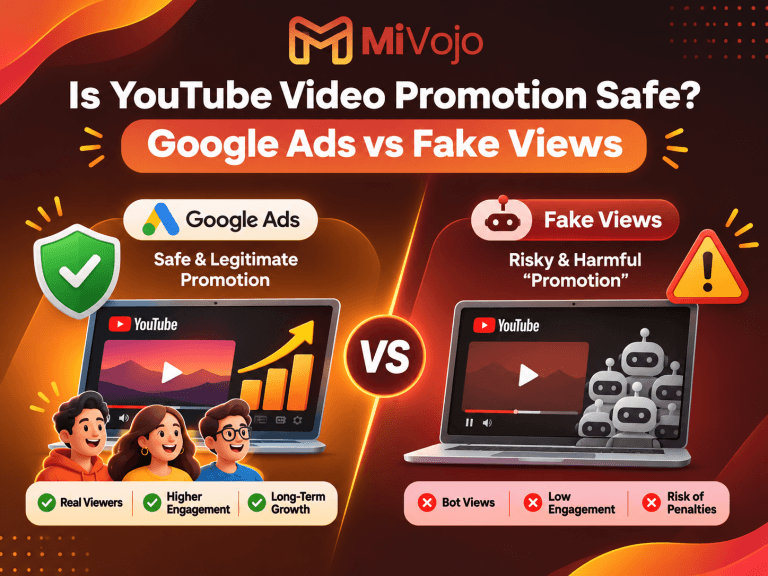
Is YouTube Video Promotion Safe? Google Ads vs Fake Views
You’ve spent weeks, or maybe months, building your YouTube channel.
You finally publish a video you’re proud of.
Then someone tells you:
“You should promote it.”
And immediately, another thought appears:
“Wait. Is YouTube video promotion actually safe?”
It’s a fair question.
The internet is full of websites promising thousands of YouTube views for suspiciously low prices. Some talk about “premium traffic.” Others promise “instant delivery,” “guaranteed subscribers,” or tens of thousands of views overnight.
At the same time, YouTube itself allows creators to promote videos through paid advertising, and Google Ads includes multiple YouTube advertising formats designed specifically to increase video exposure.
So how can one type of paid promotion be legitimate while another can put your channel at risk?
The answer comes down to where the views come from, why the viewer is watching, and how the promotion is delivered.
Let’s separate legitimate YouTube promotion from fake views once and for all.
Is YouTube Video Promotion Safe?
Yes—YouTube video promotion can be safe when it uses legitimate advertising methods such as Google Ads or YouTube Promote.
YouTube itself offers a Promote feature powered by Google Ads. According to YouTube, views and subscribers generated through Promote are legitimate, and running a promotion does not negatively affect how the video performs organically in YouTube Search or recommendations.
That is very different from purchasing artificial views from bots, traffic exchanges, click farms, or services designed only to inflate metrics.
The easiest way to understand the difference is this:
Legitimate promotion pays for distribution.
Fake-view services pay for the number to go up.
Those may sound similar, but technically and strategically they are completely different.
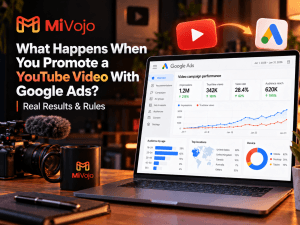
What Happens When You Promote a YouTube Video With Google Ads?
Imagine you upload a gaming video.
Organically, YouTube may show it to some subscribers, people searching for similar content, and viewers its recommendation system thinks might enjoy it.
With Google Ads, you can pay to give that video additional exposure.
Depending on the campaign, it can appear as:
skippable in-stream advertising, in-feed video advertising, YouTube Shorts advertising, or other eligible YouTube advertising placements. Google currently supports several video-ad formats, including skippable in-stream, in-feed, Shorts, bumper and non-skippable formats.
The important part is what happens next.
A real person sees the video.
They may watch.
They may skip.
They may click.
They may visit your channel.
They may later watch another video.
Advertising gives you the opportunity to be discovered.
It does not manufacture engagement.
That is why legitimate Google Ads promotion is fundamentally different from artificial traffic.
Are Google Ads YouTube Views Real?
Yes—paid advertising views can come from real viewers.
YouTube explicitly says that views and subscribers gained through its Promote campaigns are legitimate.
Google also has specific definitions for paid video views.
For example, a TrueView view can be counted when someone meaningfully watches or interacts with an eligible video ad. For skippable in-stream advertising, that generally means watching 30 seconds of a longer ad, watching the full ad when it is shorter, or interacting with the ad. In-feed and Shorts formats use different engagement thresholds.
Google separately tracks YouTube public views, which can contribute to the visible view count of a YouTube video depending on the ad format.
So if a creator sees views arriving from YouTube advertising, that does not automatically mean those views are fake.
Paid traffic and fake traffic are not synonyms.
That distinction matters.
So What Are Fake YouTube Views?
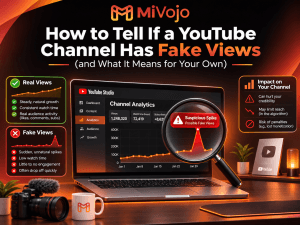
Fake views are traffic generated primarily to manipulate a video’s metrics rather than because viewers genuinely want to consume the content.
YouTube’s Fake Engagement Policy specifically prohibits artificially increasing views, likes, comments, subscribers, or other metrics through automatic systems or other manipulative methods. YouTube also warns creators that hiring somebody else to promote a channel does not remove responsibility: if the provider uses methods that violate YouTube’s policies, the creator’s channel can still be affected.
Fake traffic can include things such as automated bots, incentivized viewing networks, traffic-exchange systems, or engagement schemes designed primarily to increase numbers.
This is where creators need to be careful.
A service saying “real views” does not automatically prove anything.
You need to understand the actual traffic source.
Google Ads vs Fake Views: The Simple Test
Think of it like opening a restaurant.
Google Ads is like paying for an advertisement that says:
“Hey, this restaurant exists. You might like it.”
People see the advertisement.
Some walk in.
Some keep walking.
Some try the food and come back.
Fake views are more like paying someone to repeatedly open and close the restaurant door so the visitor counter looks impressive.
Technically, the number increases.
But you haven’t built an audience.
That is the difference.
Why YouTube Cares About Fake Views
YouTube has a strong incentive to protect the integrity of its traffic.
Advertisers are paying to reach real people.
Creators rely on analytics to understand real audience behavior.
YouTube’s recommendation systems depend on meaningful viewer signals.
If fake engagement dominated those systems, everybody would lose confidence in the platform.
That is why YouTube actively analyzes traffic for signs of invalid activity.
YouTube defines invalid traffic as activity that does not come from a real user or a user with genuine interest. Its examples include automated or incentivized third-party traffic and so-called traffic-boosting services.
When invalid traffic is detected, YouTube can adjust views, limit advertising, remove earnings associated with invalid activity, or in serious cases take action against monetization accounts.
Google Ads also continually checks advertising traffic for invalid activity. Google notes that invalid views can be removed from reporting after detection, and advertisers are not charged for invalid TrueView activity.
That should tell creators something important:
The ecosystem itself is designed to distinguish legitimate advertising from artificial traffic.
Can Fake Views Hurt a YouTube Channel?
Potentially, yes.
The risk depends on the source and severity of the artificial activity.
At the mild end, fake views may simply disappear after YouTube filters the traffic.
At the more serious end, intentionally manipulating engagement can violate YouTube’s Fake Engagement Policy. YouTube says content or channels that violate that policy can be removed, and creators can be affected even when the prohibited promotion method was used by a third party they hired.
There is another problem that receives less attention:
fake views destroy useful analytics.
Suppose you receive 30,000 artificial views.
Now you try to understand:
Which audience likes your videos?
Which countries are performing?
How long do people actually watch?
Which content produces subscribers?
Which videos should you create next?
Artificial traffic pollutes those answers.
The dashboard may look bigger while becoming less useful.
That is the exact opposite of sustainable growth.
MiVojo has a deeper guide explaining how YouTube identifies suspicious and artificial viewing patterns and why traffic source matters when evaluating YouTube views.
Does Paid YouTube Promotion Damage Organic Reach?
This is one of the biggest myths around YouTube advertising.
According to YouTube, running a promotion does not negatively affect a video’s organic performance.
Paid and organic discovery are evaluated separately. Organic recommendations depend on how the content performs when YouTube recommends it organically, rather than how it performs as advertising.
That means paying to advertise a video does not tell YouTube:
“Suppress this organically because the creator paid for traffic.”
It also does not tell YouTube:
“Rank this video higher because money was spent.”
Advertising and organic recommendation are different systems.
That distinction is useful because creators sometimes notice that paid viewers behave differently from their organic subscribers.
That is normal.
A loyal subscriber already knows who you are.
A person seeing your video through an advertisement may be meeting you for the first time.
Naturally, retention, CTR, engagement, and subscriber conversion can differ between those audiences. YouTube itself notes that paid and organic audiences can behave differently.
Do Google Ads Views Count Toward the Public YouTube View Count?
They can.
Google distinguishes between TrueView views and YouTube public views.
A TrueView view is a paid advertising metric based on specific viewing or interaction criteria.
A YouTube public view represents advertising exposure that can contribute to the publicly visible view count depending on the ad format. Google states that the public view count can include both organic views and qualifying advertising views.
This is another reason why seeing advertising-driven views on a public YouTube video should not automatically trigger alarm bells.
Paid advertising is part of YouTube’s own ecosystem.
Does Paid Promotion Count Toward YouTube Monetization?
Here is an important limitation.
Watch hours and subscribers gained directly through ad campaigns do not count toward YouTube Partner Program eligibility thresholds.
That does not mean the traffic is fake.
It means YouTube intentionally separates paid audience acquisition from the organic eligibility requirements for YPP.
So if somebody advertises:
“Buy 1,000 subscribers and instantly qualify for monetization!”
that deserves immediate skepticism.
Legitimate promotion should never be presented as a way to purchase your way into YouTube Partner Program eligibility.
Promotion is best understood as a visibility and audience-discovery tool.
What About People Who Discover You Through an Ad and Later Return?
This gets more interesting.
YouTube now reports follow-on views for certain promotion campaigns.
A follow-on view occurs when someone sees promoted content and then goes on to watch additional videos from the creator organically. YouTube states that these follow-on views are organic and can count toward YPP eligibility.
That’s an important distinction.
The original advertising activity doesn’t directly qualify.
But advertising can introduce someone to your channel.
If that person later becomes genuinely interested and continues watching your content organically, that subsequent behavior is different.
This is why creators should stop thinking about promotion as simply:
“I paid for 10,000 views.”
A better question is:
“What did those new viewers do after discovering me?”
That is a far more useful way to evaluate promotion.
Red Flags When Choosing a YouTube Promotion Service
Before buying YouTube video promotion, look closely at what the provider is actually promising.
Be particularly cautious when a service guarantees huge volumes of views at extremely low prices, cannot explain where traffic comes from, guarantees subscribers or engagement, promises monetization eligibility, requires your YouTube password, or talks vaguely about a “private network” without explaining how promotion is delivered.
A legitimate promotion service should be able to explain its traffic source.
If Google Ads is being used, that is something the provider should be comfortable saying clearly.
MiVojo’s YouTube video promotion service uses paid advertising primarily through Google Ads and YouTube advertising inventory rather than artificial engagement networks.
Can You Buy Real YouTube Views?
This question causes endless confusion because of the word buy.
Technically, yes—you can pay for advertising that generates legitimate video views.
What you are actually buying is media exposure.
You pay Google to distribute your video.
People see the advertisement.
Some viewers engage enough for the interaction to qualify as an advertising view.
That is very different from purchasing a package where somebody simply promises:
“50,000 views delivered tomorrow.”
without explaining where those viewers come from.
The better question isn’t:
“Were the views paid for?”
It is:
“How were the viewers acquired?”
That distinction separates legitimate advertising from artificial engagement.
Is Cheap YouTube Promotion Always Fake?
No.
Advertising costs vary dramatically based on audience, location, competition, targeting, placement, campaign objective, and other factors.
A worldwide campaign targeting a broad audience may have a very different cost per view from a campaign targeting a narrow, competitive U.S. audience.
So a relatively inexpensive campaign is not automatically suspicious.
The red flag is when the economics stop making sense.
If somebody promises enormous quantities of highly targeted U.S. views, guaranteed likes, guaranteed subscribers, perfect retention, and instant delivery for almost nothing, you should ask how that is actually possible.
Real advertising inventory has a cost.
Real viewers behave unpredictably.
That is normal.
Bots are much easier to guarantee.
Humans aren’t.
What Safe YouTube Video Promotion Should Look Like
Safe promotion should have one basic philosophy:
Reach real people and let them decide what happens next.
The advertiser can control distribution.
The advertiser may influence targeting.
The advertiser can optimize campaigns.
But genuine engagement must remain the viewer’s choice.
That’s why legitimate advertising can produce very different outcomes between videos.
One creator may gain subscribers.
Another may mainly gain views.
Another may see people continue watching additional content.
Another may discover that the promoted video itself isn’t converting viewers very well.
Those differences are actually a good sign.
Real audiences behave differently.
Artificial traffic tends to behave exactly as the seller promised.
How MiVojo Approaches YouTube Video Promotion
MiVojo manages YouTube video promotion using official paid advertising, primarily through Google Ads and YouTube advertising inventory.
The objective is not to manufacture engagement.
It is to give creators additional exposure to real viewers.
A creator selects a promotion package, submits the YouTube video URL, and MiVojo manages the advertising campaign. No YouTube account password is required.
Depending on the package, promotion can focus on broad reach or more specific targeting.
The philosophy is straightforward:
We can help create the introduction.
Your content has to earn the relationship.
That means likes, comments, subscriptions, sales, affiliate clicks, and long-term channel growth should never be presented as guaranteed outcomes.
Real people make those decisions themselves.
If you’re looking for legitimate YouTube video promotion through Google Ads, you can explore MiVojo’s YouTube promotion options here.
Google Ads vs Fake Views: The Bottom Line
So, is YouTube video promotion safe?
It can be.
The safety of a promotion depends far more on how the traffic is generated than on whether money was involved.
Official advertising through YouTube or Google Ads is a legitimate way to pay for video distribution. YouTube itself says views and subscribers generated through its Promote system are legitimate.
Fake engagement is different.
Bots, artificial traffic systems, incentivized engagement schemes, and services designed primarily to manipulate metrics can violate YouTube policies and create unnecessary risk.
So don’t ask only:
“Can I pay to promote my YouTube video?”
Ask:
“Where exactly will my views come from?”
If the answer is transparent, policy-compliant advertising to real audiences, you’re talking about promotion.
If nobody can clearly explain the traffic source, you’re taking a gamble with your channel.
And when you’ve spent months—or years—building that channel, that’s probably not a gamble worth taking.
Frequently Asked Questions
Is YouTube video promotion safe for my channel?
Yes, legitimate promotion through platforms such as YouTube Promote or Google Ads is an established advertising method. YouTube states that Promote does not negatively affect organic recommendations.
Are Google Ads YouTube views fake?
No. Google Ads can generate legitimate advertising views from real viewers. Google has defined criteria for TrueView views and YouTube public views across different video ad formats.
Can fake YouTube views get my channel banned?
Artificial engagement can violate YouTube’s Fake Engagement Policy. YouTube says violations may result in content removal or channel termination in serious cases.
Can paid promotion hurt my organic YouTube reach?
YouTube says promotions do not affect how videos are organically recommended because paid advertising and organic recommendations are evaluated separately.
Do promoted views count toward monetization?
Watch hours and subscribers gained directly through advertising do not count toward YPP eligibility thresholds.
Can Google Ads views appear on my public view count?
Yes. Depending on the ad format, qualifying YouTube public views from advertising can contribute to the publicly visible view count.
What is the safest way to promote a YouTube video?
Use transparent, policy-compliant methods where you know the source of the traffic. Official YouTube advertising and Google Ads are established options. Avoid services that rely on bots, artificial engagement, unexplained traffic sources, or guaranteed engagement.
How can I tell whether a YouTube promotion service is legitimate?
Ask how the video is promoted, what platform generates the traffic, whether Google Ads is used, whether the provider requires account credentials, and whether views, subscribers, likes, or monetization are guaranteed. Legitimate advertising providers should be able to clearly explain how traffic is generated.