YouTube Promotion With Google Ads: Real Results
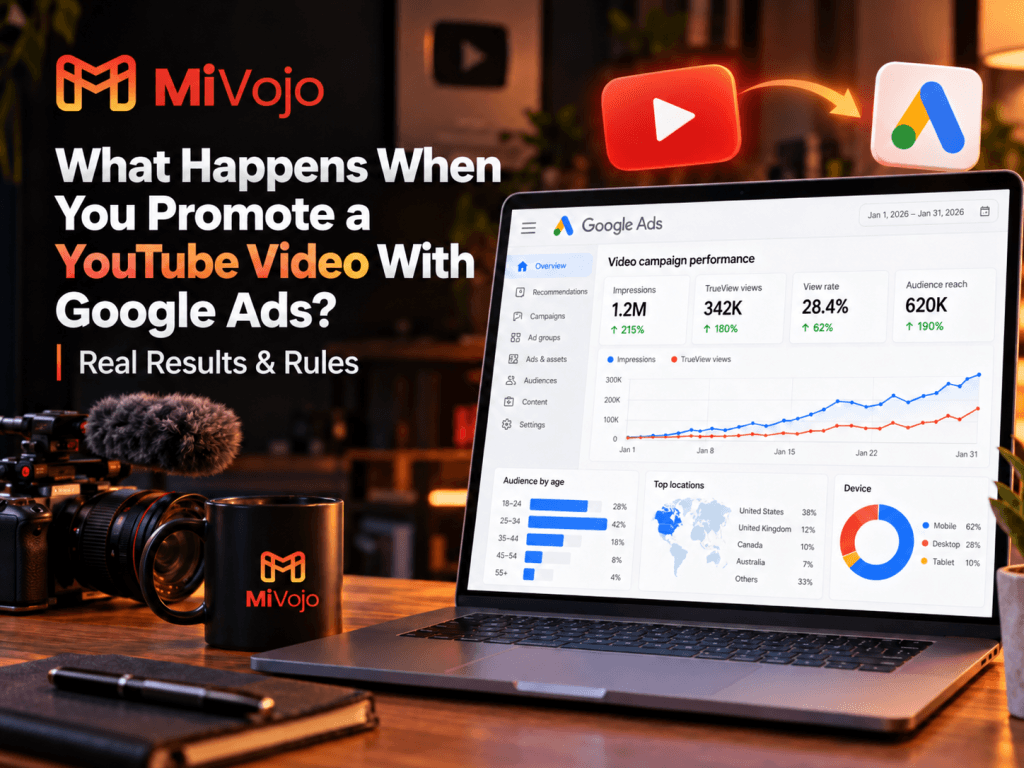
You finally upload your new YouTube video.
You’ve perfected the title, adjusted the thumbnail, edited out that awkward three-second silence, and watched the final version approximately seventeen times.
Then you publish it.
A few days later, you’re wondering why your content isn’t reaching more people.
That’s when you discover YouTube promotion.
But before spending money, you probably have a few questions.
What actually happens when you promote a YouTube video with Google Ads? Are those views real? Will your subscriber count increase? And does paid promotion help your channel grow organically?
These are important questions because YouTube advertising isn’t the same as purchasing a guaranteed audience.
Google Ads can introduce your content to real viewers, but understanding how campaigns work, what the platform measures, and what results to expect can make the difference between an informed investment and a disappointing experience.
In this guide, we’ll explore how YouTube promotion works in 2026, what Google’s official policies say, what actual campaign reporting can demonstrate, and how services like MiVojo make the process simpler for creators.
What Does It Mean to Promote a YouTube Video With Google Ads?
Promoting a YouTube video means using paid advertising to introduce that video to additional audiences.
Instead of relying exclusively on YouTube Search, recommendations, subscriptions, or external sharing, you pay for your content to appear in eligible advertising placements.
Depending on the campaign format, your video may appear before or during another video, within YouTube’s browsing experience, or among Shorts.
Google provides different video advertising formats and campaign objectives designed for reach, views, engagement, and other marketing goals.
You can explore the formats in Google Ads’ official video advertising guide.
The important distinction is this:
Google Ads helps distribute your video. It doesn’t guarantee that the people who encounter it will subscribe, return, or become loyal fans.
A useful way to think about YouTube promotion is that you’re paying for an opportunity to be discovered.
What happens after that depends on the audience and the content.
- Your Video Is Reviewed Before the Promotion Begins
One thing many first-time advertisers don’t realize is that they cannot necessarily promote every YouTube video.
Google reviews advertisements against its advertising policies.
Depending on the video, restrictions may apply to content involving sensitive subjects, copyright issues, misleading claims, prohibited products, or other policy concerns.
A video can be acceptable as a regular YouTube upload without necessarily being eligible for every advertising placement.
That’s why promotion services need to evaluate advertising eligibility before launching campaigns.
At MiVojo, we promote eligible YouTube videos through Google Ads.
If a video cannot be advertised, its eligibility needs to be addressed rather than attempting to bypass Google’s rules.
You can review the Google Ads policies to understand the general advertising requirements.
- Your Video Is Shown to an Audience Through YouTube Advertising
Once an eligible campaign is approved, Google Ads begins serving the video according to the campaign’s settings and available advertising opportunities.
Where supported by the campaign type, advertisers can choose geographic markets, languages, audience interests, demographic characteristics, and other targeting options.
For example, a creator might want to promote:
- A music video to listeners in the United States.
- An educational video to people interested in a particular subject.
- A podcast episode to audiences following related topics.
- A documentary trailer to viewers interested in its theme.
- A product demonstration to people interested in relevant technology.
The available targeting settings vary by campaign objective and format.
It’s also important to distinguish between targeting an audience and guaranteeing that audience’s behavior.
An advertiser can select people likely to be interested in a topic, but cannot force anyone to watch an entire video or become a subscriber.
This is why the quality and relevance of the video still matter.
- Google Ads Records Impressions, Views and Other Interactions
When an advertising campaign starts delivering, its performance appears in Google Ads reporting.
But there’s a detail that often confuses YouTube creators.
Not every impression is a view, and not every view is measured in the same way.
Let’s clarify the terminology.
What Is a YouTube Ad Impression?
An impression represents an eligible instance of an advertisement being shown according to Google’s measurement rules.
For example, if a video advertising campaign records 100,000 impressions, this doesn’t mean 100,000 people watched the video.
It means the campaign generated 100,000 recorded ad impressions.
An impression isn’t necessarily a unique individual, either. The same person may encounter an advertisement more than once.
What Are TrueView Views in Google Ads?
In October 2025, Google Ads renamed its familiar “Views” metric to TrueView views.
The change clarified the distinction between TrueView views and other types of YouTube view reporting.
According to Google Ads’ official view metric documentation, the criteria for counting a TrueView view depend on the advertising format.
For example:
Skippable in-stream ads: A TrueView view can be counted when someone watches 30 seconds, watches the entire ad if it’s shorter, or interacts with the ad.
In-feed ads: A TrueView view can be counted when someone chooses to watch through an eligible thumbnail click or meets the applicable autoplay viewing threshold.
YouTube Shorts ads: The TrueView view criteria include watching for the specified duration or interacting with an eligible call to action.
In other words, there isn’t one universal rule that every advertised video must be watched for 30 seconds to count.
Different formats have different definitions.
TrueView Views vs YouTube Public Views
Google Ads also distinguishes between TrueView views and YouTube public views.
Public views are relevant to the visible view count displayed on YouTube, while TrueView views are used for specific advertising performance and billing measurements.
As a result, a creator may notice differences between the views reported in Google Ads and the public view count displayed beneath a video.
That doesn’t automatically indicate an error or artificial traffic.
The metrics simply don’t always represent identical events.
This distinction is particularly important when evaluating a promotion service’s reporting.
- Are Views From Google Ads Real YouTube Views?
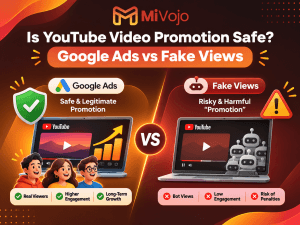
Yes. Official YouTube promotion generates legitimate advertising views rather than simulated views created by automated accounts.
Google’s official YouTube Promote FAQ explicitly confirms that views and subscribers obtained through its Promote service are legitimate.
That’s a meaningful difference from services that use bots, click farms, or artificial engagement.
However, legitimate doesn’t necessarily mean highly engaged.
A real person might encounter your video, watch long enough to generate a counted view, and never return to your channel.
Another person might enjoy the content, subscribe, and watch several additional videos.
Both experiences can begin with legitimate advertising.
Real views create an opportunity for engagement. They aren’t a guarantee of it.
For a deeper explanation, read our article Authentic YouTube Views: What They Are and Why They Matter in 2026.
- Can YouTube Promotion Generate Subscribers?
Yes, people who discover content through advertising can choose to subscribe to a channel.
But subscriber growth isn’t guaranteed, and it should not be confused with the delivery of video views.
Think about your own YouTube habits.
You probably watch plenty of interesting videos without subscribing to every creator.
Sometimes you enjoy one video but don’t need more content on that topic.
Other times, you discover a channel, watch a few additional uploads, and decide you want to follow it.
Paid viewers can behave in similar ways.
What Are Earned Actions in Google Ads?
Google Ads provides additional reporting metrics known as earned actions.
These can include earned views, likes, subscribers, shares, and playlist additions after someone watches an advertisement and subsequently interacts with a linked YouTube channel within the applicable attribution period.
Google explains these metrics in its official YouTube ads and view metrics documentation.
For creators, earned actions provide useful information about engagement beyond the original advertising view.
However, their availability depends on the relevant account settings and reporting conditions.
A large number of paid views with few earned actions may suggest that the content attracted attention without encouraging many viewers to explore further.
That isn’t necessarily campaign failure. It depends on whether the original objective was awareness, video views, or deeper engagement.
- Does YouTube Advertising Help Your Videos Rank Higher Organically?
This is one of the most misunderstood aspects of paid YouTube promotion.
Some creators believe that purchasing a large number of legitimate views automatically convinces YouTube’s algorithm to recommend their content more frequently.
That isn’t how YouTube officially describes its recommendation system.
YouTube states that paid promotion does not directly determine the organic recommendation performance of a video or channel.
Organic recommendations depend on how content performs when presented to viewers organically.
You can read this explanation in YouTube’s official Promote documentation.
So Can Promotion Still Have Long-Term Value?
Potentially, yes.
A paid campaign might introduce your channel to someone who later returns independently.
That person might watch another upload, subscribe, or recommend your content to a friend.
Your campaign may also give you useful information about which videos and audiences respond better.
But these are possible downstream benefits, not an automatic algorithmic boost.
You’re paying for advertising exposure, not purchasing a higher position in YouTube Search.
If you want to explore this distinction further, read The Long-Term Benefits of Promoting Your YouTube Videos With Google Ads.
- Do Google Ads Views Count Toward YouTube Monetization?
Here’s another important question creators frequently ask.
If you promote a video and receive thousands of views, do those views help you qualify for the YouTube Partner Program?
Not in the way many beginners expect.
YouTube states that watch hours and subscribers gained through advertising campaigns do not count toward YouTube Partner Program eligibility thresholds.
For the standard advertising revenue-sharing route, the familiar eligibility requirements include 1,000 subscribers and either 4,000 qualified public watch hours during the preceding 365 days or 10 million qualified public Shorts views during the preceding 90 days.
Additional eligibility conditions and alternative thresholds apply to certain features and regions.
You can review the current YouTube Partner Program monetization requirements.
Does This Mean Paid Promotion Is Useless for Channel Growth?
No.
It means creators need to distinguish between two goals:
Increasing video visibility through advertising and meeting YouTube’s monetization eligibility requirements.
They’re not the same thing.
A legitimate campaign can help more people discover your video even though its paid views don’t satisfy the watch-hour requirement.
If your only objective is to purchase enough advertising views to reach 4,000 monetization watch hours, you’re approaching the problem incorrectly.
However, if your objective is to reach new audiences and build awareness around your content, YouTube advertising can still be relevant.
- What Real YouTube Promotion Results Look Like: A MiVojo Case Study
Let’s move beyond definitions and examine an actual promotion example.
MiVojo has published results from a YouTube promotion case study involving a product review channel.
Across the reported campaigns, the advertising generated:
Reported metric | Result |
Google Ads impressions | 4.05 million |
TrueView views | 498,300 |
Campaign period | November 2025 – June 2026 |
During the broader observation period, the channel’s subscriber count increased from approximately 269,000 to 414,000.
That’s an increase of around 145,000 subscribers.
What Do These Numbers Actually Prove?
The Google Ads figures demonstrate substantial paid distribution and recorded TrueView views across the campaigns.
The subscriber figures demonstrate that the channel’s overall subscriber count increased during the same period.
But here’s where responsible reporting matters.
We cannot conclude that all 145,000 additional subscribers were directly generated by advertising.
Organic recommendations, existing subscribers sharing content, new uploads, external promotion, and other factors may have contributed.
Likewise, 4.05 million impressions do not represent 4.05 million unique viewers.
What About View Rate?
Dividing 498,300 TrueView views by 4.05 million impressions produces approximately 12.3%.
This is a useful directional ratio for understanding the scale of the reported view activity relative to reported impressions.
However, it should not automatically be presented as Google’s official format-specific TrueView view rate, because that metric uses eligible impressions and may exclude certain ad formats.
To calculate the official metric precisely, we would need the corresponding Google Ads reporting columns.
The real lesson from this case study is that paid YouTube promotion can produce measurable distribution at scale.
It does not prove that every channel will achieve the same results, or that advertising alone caused the full subscriber increase.
Why We Share Campaign Results
At MiVojo, we believe promotion should be evaluated using understandable performance information rather than vague promises.
That’s why it’s important to discuss impressions, views, engagement, targeting, and the limitations of campaign attribution.
A video promotion service should explain what it delivers and what remains outside its control.
- How Much Does It Cost to Promote a YouTube Video?
YouTube advertising costs depend on several factors, including:
- The campaign objective and format.
- Target countries and available advertising inventory.
- Audience characteristics.
- Competition among advertisers.
- Video content and ad performance.
- Campaign bidding settings.
A campaign targeting one market may have a different cost per view from a campaign targeting another.
Similarly, two videos aimed at comparable audiences may generate different performance because their openings, content, or formats encourage different viewing behavior.
Understanding Cost Per View
For applicable cost-per-view campaigns, advertisers can use the TrueView cost-per-view metric to understand the cost associated with recorded TrueView views.
Google provides more information in its official CPV bidding guide.
However, lower costs aren’t automatically better.
Suppose one campaign reaches people who have little interest in your content, while another reaches viewers who are more relevant to your subject.
The cheaper campaign may generate more views per dollar, but the more relevant campaign could provide greater value for awareness or future engagement.
The appropriate approach depends on your goals.
Is YouTube Promotion Worth Paying For?
It can be, especially when you have clear objectives and a video that is ready to reach more people.
But paid promotion isn’t necessary for every upload.
Some videos are better suited to organic search, collaborations, community sharing, or short-form content.
For a broader breakdown of free and paid distribution, explore our guide 10 Ways to Promote YouTube Videos in 2026.
- How MiVojo Makes YouTube Promotion Easier
Managing a Google Ads campaign involves selecting settings, understanding different advertising formats, monitoring eligibility, and interpreting performance results.
Not every YouTube creator wants to become an advertising specialist.
And that’s understandable.
You may be excellent at producing documentaries, creating educational content, recording music, or developing entertaining videos without wanting to spend your evenings figuring out advertising dashboards.
That’s where MiVojo comes in.
MiVojo helps creators promote eligible YouTube videos through official Google Ads campaigns.
Our service focuses on legitimate paid promotion, helping content reach real viewers through available geographic and audience targeting options.
How It Works
Choose your promotion package. Select a YouTube video promotion package that fits your needs.
Provide your video URL. Submit the eligible public YouTube video you want to promote.
Choose available targeting preferences. Depending on the service and campaign, select relevant geographic or audience options.
MiVojo handles the advertising process. We manage the campaign through Google Ads.
Review your results. Understand the delivered promotion using the reporting provided for your order.
You don’t need to share your YouTube password or provide administrator access to your channel.
What MiVojo Does — and Doesn’t — Promise
Our goal is to provide legitimate video promotion.
We do not use bot-generated views or artificial engagement to simulate popularity.
We also don’t guarantee that advertising will produce subscribers, sales, monetization eligibility, or higher organic rankings.
Those outcomes depend on viewer behavior, content relevance, channel characteristics, and other factors.
You create the content. We help it reach more real viewers.
Explore MiVojo’s YouTube Promotion Packages →
- How to Measure Whether Your YouTube Promotion Was Successful
After a campaign finishes, resist the temptation to evaluate everything using only the public view counter.
Views are important, but they are only one piece of the picture.
Here are several useful measurements.
Metric | What It Helps Explain |
Impressions | How extensively the ad was served |
TrueView views | Eligible viewing activity measured by Google Ads |
TrueView CPV | Cost associated with paid TrueView views |
TrueView view rate | Share of eligible impressions resulting in TrueView views |
Earned actions | Certain follow-up interactions associated with ad viewers |
Audience retention | How viewing behavior changes throughout the video |
Subscriber activity | Whether additional channel interest developed |
Google also distinguishes advertising performance from organic performance.
These should be evaluated separately because people discovering a video through an ad may behave differently from those encountering it organically.
You can find more information in Google Ads’ official video performance measurement guide.
The best measurement approach starts by answering a simple question:
What were you trying to achieve?
If the objective was awareness, relevant reach and video views may be central.
If the objective was attracting subscribers, examine subscriber-related activity and future audience engagement.
If the objective was selling a product, video views alone aren’t sufficient. You also need suitable conversion tracking.
A successful campaign is one that delivers meaningful results against its original purpose.
Frequently Asked Questions About Promoting YouTube Videos
What Happens When You Pay to Promote a YouTube Video?
Your eligible video is distributed through Google’s advertising system to audiences determined by the campaign’s settings.
Google Ads records delivery and engagement metrics, including applicable impressions, TrueView views, costs, and other interactions.
Results depend on the selected objective, format, audience, budget, and content.
Are YouTube Views From Google Ads Real?
Yes. Views generated through official YouTube advertising come from legitimate promotion rather than automatically manufactured traffic.
However, a real paid view doesn’t guarantee that someone will subscribe or watch additional videos.
Will My Video Get More Organic Views After a Google Ads Campaign?
Not necessarily.
YouTube states that paid promotion doesn’t directly boost organic recommendation performance.
Some advertised viewers may independently return to your channel, but this outcome isn’t guaranteed.
Can YouTube Ads Get Me Subscribers?
Yes, viewers exposed to your advertisements can choose to subscribe.
However, YouTube advertising doesn’t guarantee subscriber acquisition, and subscriptions attributable to ad campaigns don’t count toward Partner Program eligibility thresholds.
Do Google Ads Views Count Toward 4,000 Watch Hours?
No. Watch hours generated through paid advertising campaigns don’t count toward YouTube Partner Program eligibility.
Qualified organic watch time is subject to the program’s separate requirements.
What’s the Difference Between TrueView Views and Public YouTube Views?
TrueView views follow format-specific advertising measurement criteria and are relevant to certain advertising billing and performance metrics.
YouTube public views contribute to the publicly displayed view count and may follow different counting conditions.
The two measurements aren’t always identical.
Can I Promote Someone Else’s YouTube Video?
Eligible videos may be used in advertising when the advertiser has the necessary permissions and complies with applicable Google Ads, YouTube, copyright, and other policies.
Being publicly available on YouTube doesn’t automatically grant unrestricted advertising rights.
Is Paying for YouTube Promotion Safe?
Official Google Ads promotion is a legitimate advertising method when campaigns and content comply with applicable policies.
Avoid providers using artificial views, automated engagement, or misleading promises.
How Long Does YouTube Promotion Take?
Timing varies according to ad review, campaign settings, audience availability, budget, and delivery conditions.
No legitimate provider can guarantee that every video will be approved or begin delivering immediately.
Final Thoughts: YouTube Promotion Is About Real Exposure, Not Algorithm Tricks
Promoting a YouTube video with Google Ads in 2026 can be a useful way to introduce your content to new audiences.
But successful promotion begins with realistic expectations.
Official advertising can generate impressions, TrueView views, public views, and opportunities for engagement.
It cannot guarantee that viewers will become subscribers, purchase products, or return to your channel.
It also doesn’t purchase better organic rankings or shortcut YouTube’s monetization eligibility rules.
At MiVojo, we believe creators deserve to understand exactly what they’re paying for.
That’s why our YouTube promotion services are based on official advertising, real viewers, and transparent expectations.
Whether you’re launching your first video or introducing an established channel to a new audience, the goal is the same:
Give your content a better opportunity to be discovered by real people.