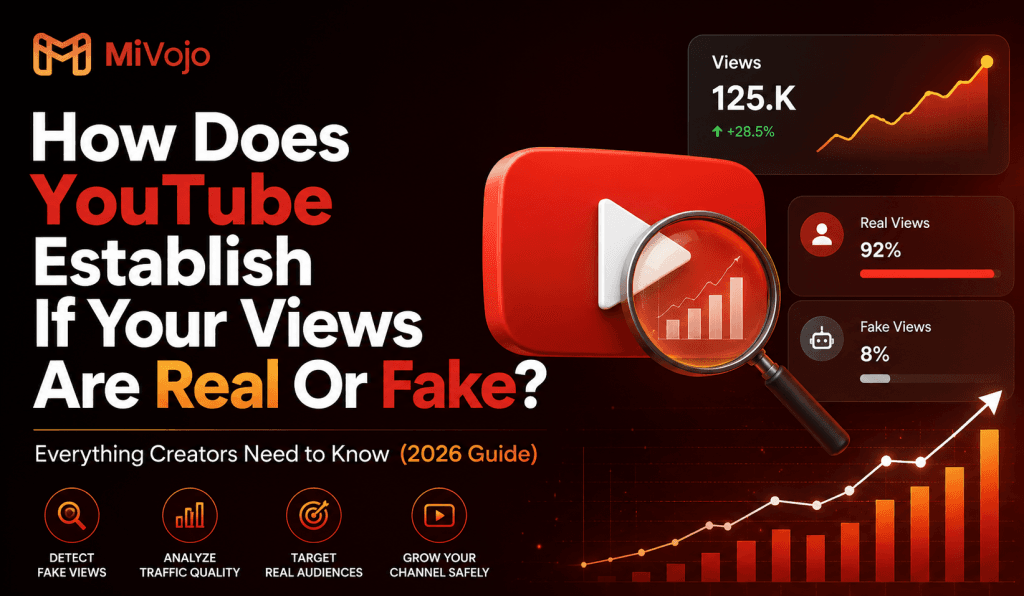
How Does YouTube Establish If Your Views Are Real Or Fake
Every creator wants more views.
Unfortunately, that desire has created an entire industry built around selling fake engagement, bot traffic, and artificial views.
The problem?
YouTube has spent years improving its systems to identify invalid traffic, suspicious engagement patterns, and activity that doesn’t reflect genuine viewer interest.
If you’ve ever wondered:
- Does YouTube detect fake views?
- Can fake views disappear?
- Can purchased views hurt a channel?
- How does YouTube know whether a view is real?
This guide explains how YouTube evaluates views, what invalid traffic means, and why real audience engagement remains the foundation of long-term channel growth.
Table of Contents
- What Counts as a YouTube View?
- What Are Fake Views?
- How YouTube Detects Invalid Traffic
- Common Types of Fake Views
- Real Views vs Fake Views
- What Happens When YouTube Detects Fake Views?
- Can Fake Views Affect Monetization?
- Examples of Real vs Artificial Traffic
- How to Promote Videos Safely
- Frequently Asked Questions
- Final Thoughts
What Counts as a YouTube View?
Before understanding fake views, it’s important to understand what YouTube considers a legitimate view.
A view is not simply someone clicking a video.
YouTube evaluates various signals that suggest a real person intentionally watched content.
Examples include:
- Actual viewing activity
- Viewing duration
- Viewer behavior
- Engagement patterns
- Device and network information
The exact systems YouTube uses are proprietary and constantly evolving, but the platform’s objective is simple:
Reward genuine viewer interest while filtering artificial activity.
Why YouTube Cares About Fake Views
YouTube’s entire business model depends on trust.
Advertisers spend billions of dollars each year because they believe they are reaching real people.
If fake traffic dominated the platform:
- Advertisers would lose confidence
- Analytics would become unreliable
- Recommendations would become less useful
As a result, YouTube continuously invests in systems designed to identify suspicious activity and maintain platform integrity.
What Are Fake Views?
Fake views are views generated without genuine viewer interest.
The viewer either:
- Isn’t a real person
- Didn’t intentionally choose the content
- Is part of a manipulated traffic source
Common examples include:
Bots
Automated software programmed to repeatedly watch videos.
Click Farms
Groups of individuals paid to watch content for engagement purposes.
Traffic Exchanges
Networks where users exchange views rather than consuming content naturally.
Artificial Incentives
Systems that reward users for viewing videos solely to generate metrics.
The common characteristic is simple:
The view exists primarily to inflate numbers rather than reflect genuine audience interest.
How YouTube Detects Invalid Traffic
One of the most common questions creators ask is:
“How does YouTube know?”
While YouTube does not publicly disclose every signal it uses, there are several indicators that likely help identify suspicious activity.
- Viewing Patterns
Real people behave differently than automated systems.
Human viewers:
- Watch at different times
- Skip around videos
- Pause content
- Exit early
- Return later
Bots often create repetitive patterns that are easier to identify.
Example:
10,000 views arriving within minutes from nearly identical devices may appear suspicious compared to organic growth patterns.
- Audience Retention Signals
Retention often reveals a lot about traffic quality.
Example:
Scenario | Real Audience | Fake Traffic |
Average Watch Duration | 3-8 minutes | Few seconds |
Session Length | Variable | Uniform |
Engagement | Natural | Minimal |
Viewer Behavior | Diverse | Repetitive |
When thousands of viewers leave immediately, systems may evaluate whether that traffic reflects genuine interest.
- Device and Network Data
YouTube can evaluate:
- IP addresses
- Device characteristics
- Browser information
- Network patterns
If unusual concentrations of activity originate from suspicious sources, those views may receive additional scrutiny.
- Engagement Consistency
YouTube doesn’t evaluate views in isolation.
The platform can compare:
- Views
- Likes
- Comments
- Shares
- Watch time
- Returning viewers
Example:
A video with:
- 100,000 views
- 2 comments
- Extremely low watch duration
may look very different from a video with genuine audience engagement.
- Traffic Source Analysis
Where viewers come from matters.
Traffic from:
- Search
- Suggested Videos
- Browse Features
- External Websites
- Google Ads
can be evaluated differently from suspicious traffic networks.
The platform continuously analyzes whether traffic sources appear legitimate.
Common Types of Fake Views
Not all artificial traffic looks the same.
Understanding the differences helps creators avoid risky services.
Bot Views
The most obvious form.
Automated software repeatedly loads videos to generate views.
Click Farm Traffic
Human-operated but not genuinely interested viewers.
These views exist solely to inflate metrics.
Low-Quality Incentivized Traffic
Users receive rewards for watching videos.
Interest in the content itself is often minimal.
Traffic Exchange Networks
Creators exchange views with one another.
While participants are real people, viewing behavior is often unnatural and engagement quality is generally poor.
Real Views vs Fake Views
This is where many creators become confused.
Not all purchased traffic is automatically fake.
The critical difference is audience intent.
Factor | Real Views | Fake Views |
Genuine Interest | ✓ | ✗ |
Audience Retention | Higher | Lower |
Subscriber Potential | ✓ | Limited |
Organic Growth Potential | ✓ | Low |
Meaningful Engagement | ✓ | Rare |
Analytics Accuracy | ✓ | Distorted |
A real view comes from someone who genuinely chooses to watch.
A fake view exists primarily to manipulate metrics.
What Happens When YouTube Detects Fake Views?
Many creators discover this the hard way.
Sometimes views suddenly disappear.
That’s because YouTube routinely audits traffic and removes invalid activity.
Possible outcomes include:
View Adjustments
Suspicious views may be removed from public counts.
Analytics Corrections
Traffic reports may change after validation processes occur.
Reduced Data Accuracy
Artificial traffic makes it harder to understand real audience behavior.
Potential Policy Concerns
Attempting to manipulate metrics may create risks for channels over time.
For a deeper discussion, see:
YouTube Consequences for Fake Views: What You Need to Know Before Promoting Your Videos
Can Fake Views Affect Monetization?
This is one of the biggest concerns among creators.
YouTube’s monetization systems are designed to reward authentic audience engagement.
Artificial traffic may create several issues:
- Reduced trust in analytics
- Lower audience quality
- Less reliable performance signals
Most importantly:
Fake views do not build a real audience.
Even if view counts increase temporarily, creators still need:
- Watch time
- Subscribers
- Returning viewers
- Meaningful engagement
For more information on monetization goals, read:
How Long Does It Take to Reach 4,000 Watch Hours on YouTube?
Real-World Example
Let’s compare two hypothetical videos.
Video A
- 20,000 real views
- 4-minute average watch duration
- Strong retention
- 200 new subscribers
Video B
- 50,000 artificial views
- 10-second average watch duration
- No subscriber growth
- Minimal engagement
Which video helps a creator grow?
Almost always Video A.
Growth comes from audience quality, not inflated metrics.
Why Creators Buy Fake Views
Most creators who purchase fake traffic are not trying to deceive anyone.
They’re usually frustrated.
Common reasons include:
- Slow growth
- Lack of visibility
- Competition
- Unrealistic expectations
Unfortunately, fake traffic rarely solves those problems.
It often creates new ones.
How to Promote Videos Safely
If fake views aren’t the answer, what is?
Successful creators focus on attracting relevant audiences.
Examples include:
Search Optimization
Well-optimized titles and descriptions improve discoverability.
Better Thumbnails
Higher click-through rates often generate more growth than increased upload frequency.
Communities
Relevant forums and communities can provide highly engaged viewers.
Collaborations
Partnering with other creators exposes content to new audiences.
Legitimate Advertising
Advertising platforms can help introduce content to viewers who may actually be interested in it.
For additional strategies, see:
- 10 Ways to Promote YouTube Videos
- The Ultimate YouTube Promotion Checklist
- How to Get 1,000 Views on YouTube for Free
Real Views, Real Results
One of the biggest misconceptions in YouTube marketing is that all promotion services operate the same way.
They do not.
Feature | Real Audience Promotion | Fake View Services |
Real People | ✓ | Often No |
Audience Targeting | ✓ | Limited |
Viewer Interest | ✓ | Uncertain |
Long-Term Growth Potential | ✓ | Low |
Analytics Quality | ✓ | Distorted |
Sustainable Channel Growth | ✓ | Unlikely |
The objective should always be attracting viewers who genuinely care about your content.
Frequently Asked Questions
Does YouTube detect fake views?
Yes. YouTube continuously evaluates traffic quality and may remove invalid views from public counts and analytics.
Can fake views disappear?
Yes. YouTube periodically reviews traffic and may adjust metrics if activity appears invalid.
Are bot views the same as real promotion?
No. Bot traffic and legitimate audience acquisition are fundamentally different.
Can fake views help monetization?
Artificial traffic generally does not create the audience engagement required for long-term channel growth.
Can YouTube flag suspicious traffic?
YouTube monitors activity across the platform and evaluates whether engagement patterns appear legitimate.
What’s the difference between real and fake views?
Real views come from genuine viewer interest. Fake views exist primarily to inflate metrics.
Final Thoughts: Focus on Audience Quality, Not View Counts
The question creators should ask isn’t:
“How can I get more views?”
It’s:
“How can I get more of the right viewers?”
YouTube’s systems are becoming increasingly sophisticated at identifying genuine audience behavior.
As a result, the most sustainable growth strategy remains the same as it has always been:
- Create valuable content
- Improve retention
- Optimize discoverability
- Attract relevant audiences
At MiVojo, we believe creators should focus on reaching real viewers rather than chasing artificial engagement.
Our promotion approach is designed around visibility and audience targeting rather than fake metrics. We do not sell bot traffic, fake views, guaranteed monetization, or artificial engagement.
The goal isn’t simply increasing numbers.
The goal is helping creators reach people who genuinely want to watch their content.