The Shift Has Already Happened
For years, brands treated YouTube as a “nice-to-have” awareness channel.
That assumption is now outdated.
YouTube has quietly evolved into one of the few platforms that can simultaneously scale reach, influence decisions, and drive measurable action, something even traditional performance channels struggle to do at scale.
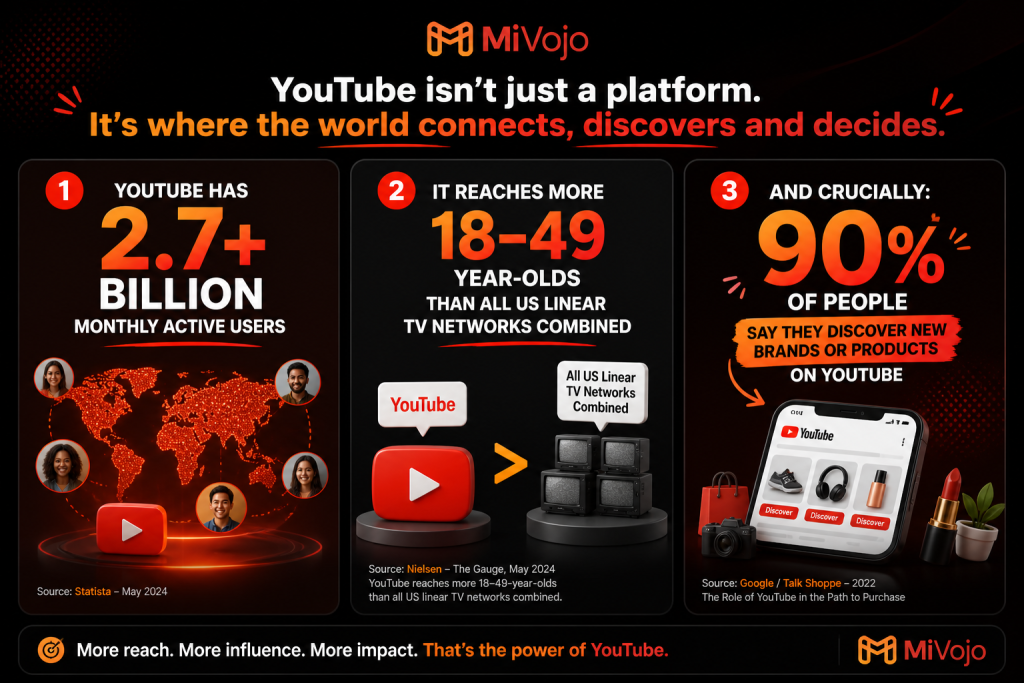
- YouTube has 2.7+ billion monthly active users
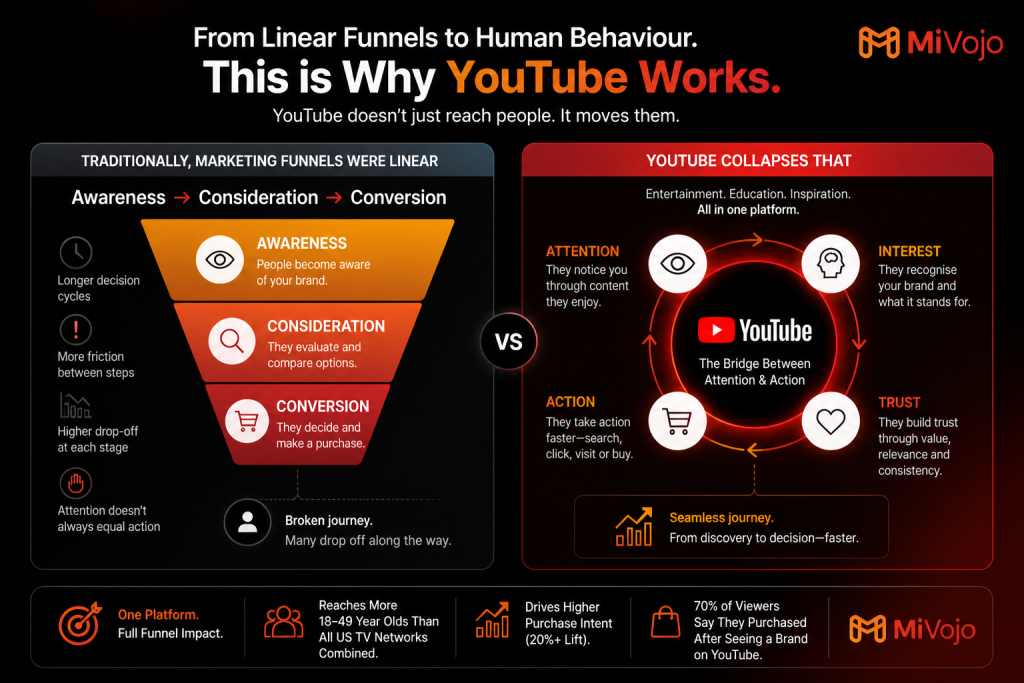
- It reaches more 18–49-year-olds than all US linear TV networks combined
- And crucially: 90% of people say they discover new brands or products on YouTube
This is not just reach. This is market influence at scale.
From Awareness to Action: The Misunderstood Role of YouTube
The biggest misconception is simple:
“YouTube is for branding, not performance.”
The data says otherwise.
- 70% of viewers say they bought from a brand after seeing it on YouTube
- YouTube campaigns consistently drive significant lifts in purchase intent and ad recall
- Google’s own studies show video can increase purchase intent by over 20%
The conclusion is not that YouTube replaces performance channels.
It’s that:
YouTube compresses the funnel.
It builds demand and captures it, often within the same ecosystem.
What Real Campaign Data Looks Like (MiVojo Case)
Theory matters. But execution matters more.
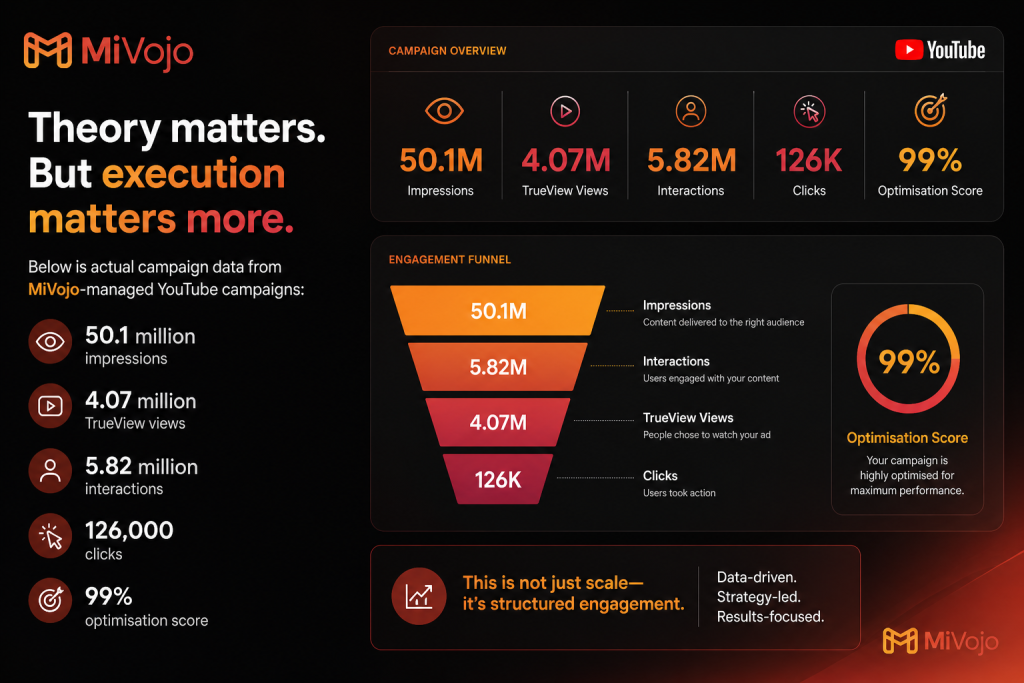
Below is actual campaign data from MiVojo-managed YouTube campaigns:
- 50.1 million impressions
- 4.07 million TrueView views
- 5.82 million interactions
- 126,000 clicks
- 99% optimisation score
This is not just scale, it’s structured engagement.
Engagement vs Intent: What the Numbers Actually Reveal
At first glance, most marketers look at impressions and clicks.
That’s a mistake.
The real story is in how users behave across devices.
- Where Attention Happens
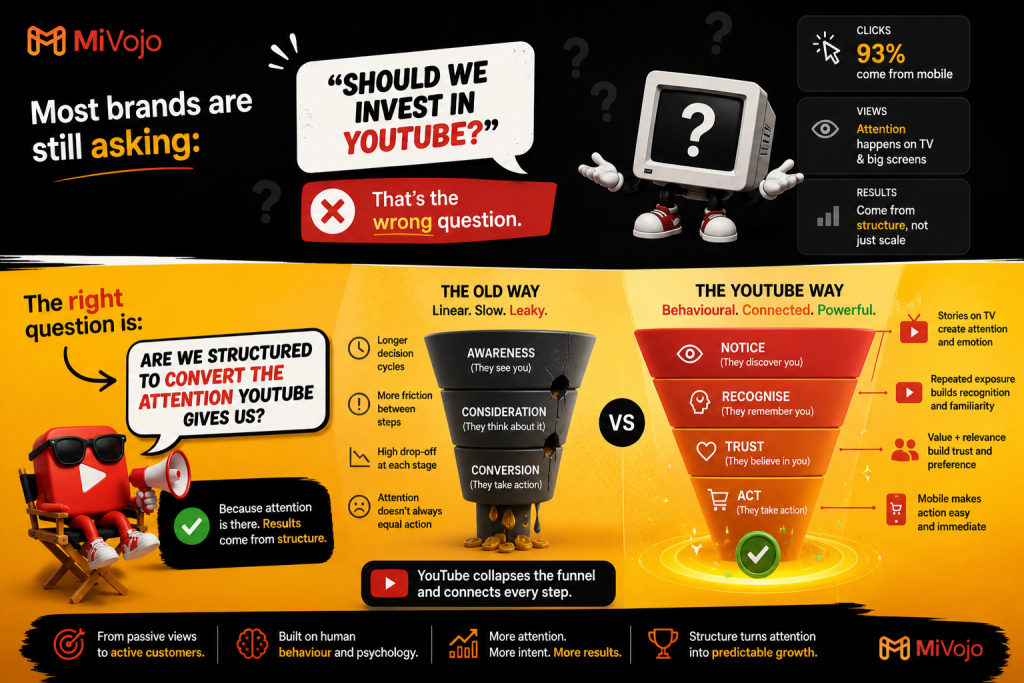
- 55.8% of TrueView views come from TV screens
- Only 37.6% from mobile
This is critical.
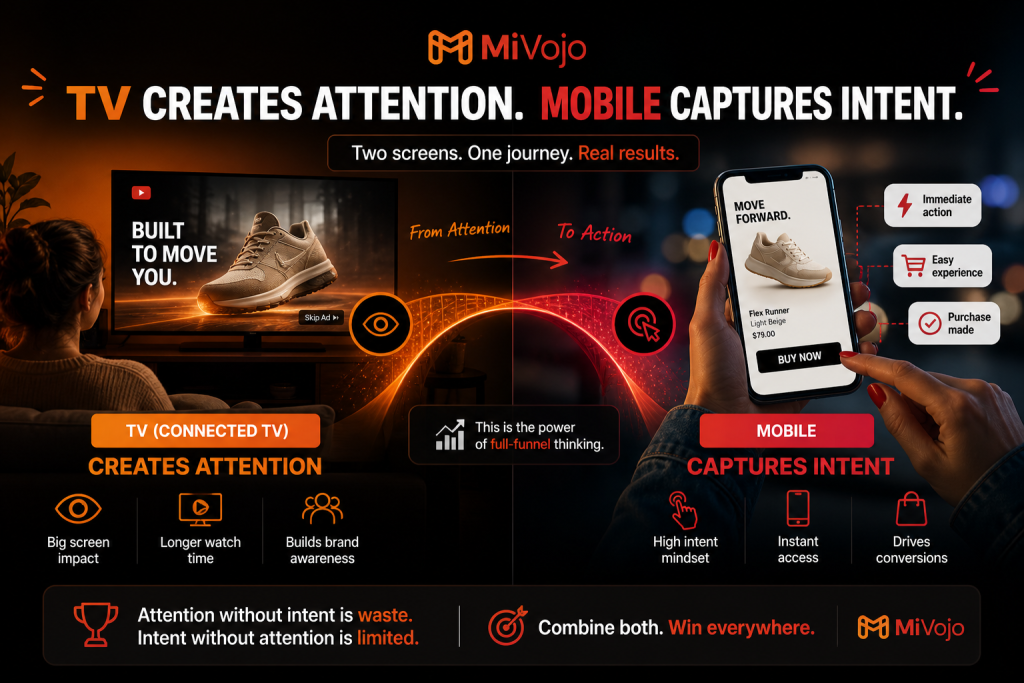
TV (Connected TV) is where users lean back and consume.
This aligns with broader research:
- Connected TV drives higher completion rates and longer watch time
- Where Action Happens
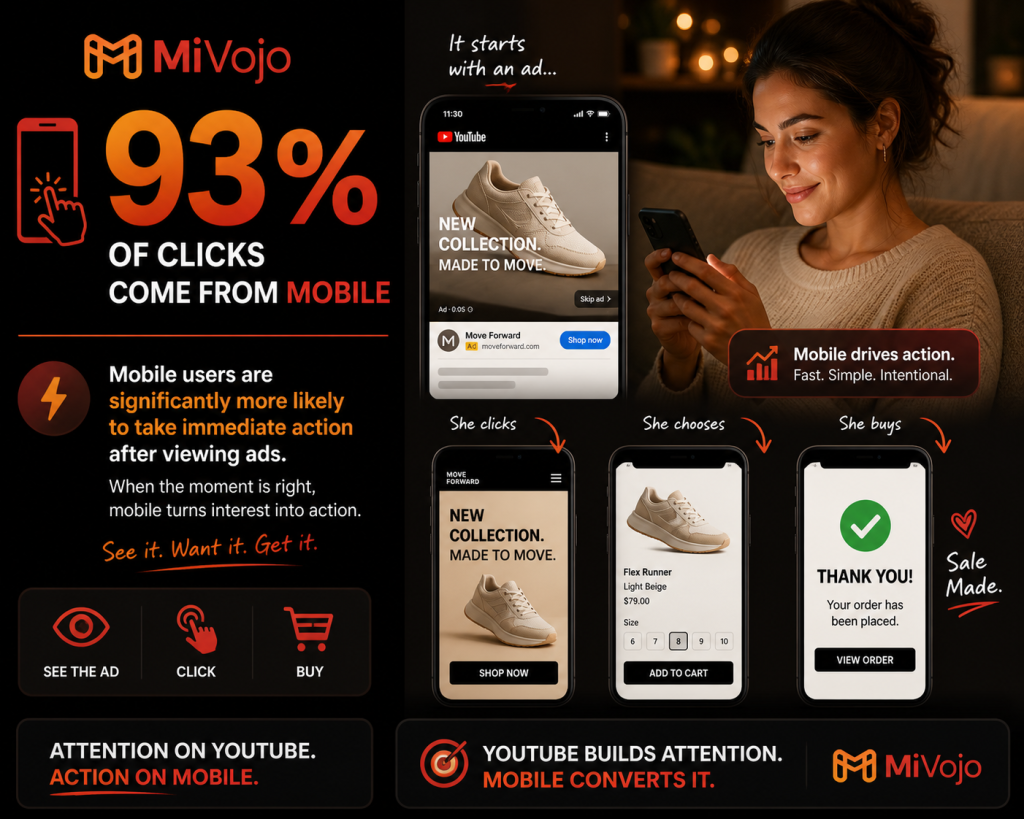
- 93% of clicks come from mobile
Mobile users are significantly more likely to take immediate action after viewing ads
The Insight Most Brands Miss
When you combine both datasets, a clear system emerges:
TV creates attention. Mobile captures intent. This is not theoretical. It is directly visible in the data.
What Actually Works (Based on Data, Not Opinion)
When campaigns are structured correctly, YouTube becomes a full-funnel engine.
The MiVojo approach is based on aligning:
- Device Behaviour
- TV → storytelling, attention, emotional impact
- Mobile → clarity, urgency, action
- Creative Structure
- First 3 seconds = pattern interrupt
- Immediate value delivery
- Clear next step
This aligns with how users actually consume video, not how brands wish they did.
- Sequential Strategy
Instead of running isolated ads:
- First exposure → awareness (TV-heavy)
- Second exposure → reinforcement
- Third exposure → action (mobile-driven)
What the 50M+ Dataset Really Proves
The MiVojo dataset is not just large, it’s revealing.
It shows that:
- YouTube can scale reach massively (50M+ impressions)
- Users actively engage (5.82M interactions)
- A meaningful portion converts (126K clicks)
But more importantly:
It shows that performance is not random, it’s structured.
When strategy aligns with behaviour, results follow.
- Why YouTube Influences Decisions (Not Just Awareness)
The platform doesn’t just show ads—it guides behaviour.
- 70% of viewers say they bought from a brand after seeing it on YouTube
- YouTube plays a key role in evaluation and comparison before purchase
This aligns with decision science:
People don’t make decisions instantly.
They accumulate signals until action feels justified.
YouTube accelerates that process.
- The Role of Emotion + Logic (System 1 vs System 2)
From behavioural economics (Daniel Kahneman’s framework):
- System 1 → fast, emotional, intuitive
- System 2 → slow, rational, analytical
YouTube activates both:
On TV / long-form video
- Emotional storytelling
- Visual immersion
- Passive engagement
→ System 1 dominance (attention + feeling)
On mobile / shorter formats
- Quick decisions
- Clear CTAs
- Immediate action
→ System 2 activation (choice + action)
This is exactly why:
TV creates attention. Mobile captures intent.
And why YouTube works across the full decision journey.
- The Compression of the Funnel
Traditionally, marketing funnels were linear:
Awareness → Consideration → Conversion
YouTube collapses that.
Because:
- Users can discover, evaluate, and act within minutes
- Video accelerates trust-building
- Mobile enables instant response
Supporting data:
- Video can increase purchase intent by 20%+
- Why This Matters More in 2026
Consumer behaviour has changed:
- Attention spans are shorter
- Decision cycles are faster
- Trust is harder to earn
Platforms that separate awareness and action are losing efficiency. Platforms that connect them are winning. YouTube is one of the few that does both, at scale.
YouTube works not because it is a video platform.
It works because it aligns with how humans naturally think and decide:
- We notice →
- We recognise →
- We trust →
- We act
Most platforms only influence one or two of these steps.
YouTube connects all four.
Built for Brands That Want More Than Just Reach
If you’re serious about turning YouTube into a real growth channel—not just a visibility play, that’s exactly where MiVojo comes in.
We don’t just run ads.
We design systems that:
- Turn attention into measurable intent
- Turn views into real business outcomes
- Turn YouTube into a predictable acquisition engine
If you’re still asking whether YouTube works, you’re too early.
If you’re ready to make it work properly, we should talk.
👉 Let’s build something that actually converts: MiVojo
Sources
- Statista — Global social network users
- Think with Google — YouTube reach vs TV
- Think with Google — YouTube path to purchase
- Think with Google — YouTube influence on purchases
- Think with Google — YouTube ad effectiveness
- Think with Google — Video marketing statistics
- Think with Google — Connected TV insights
- Statista — Mobile advertising behaviour